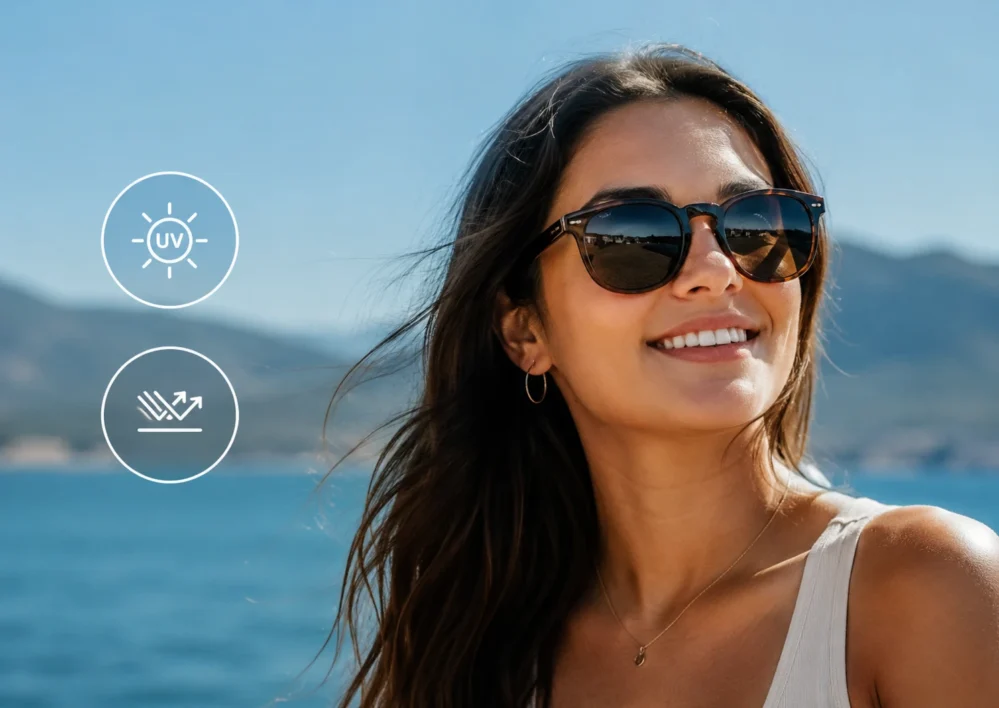
Have you ever bought a pair of sunglasses because they looked great, only to wonder later whether they actually protect your eyes? You’re not alone. Many sunglasses have dark lenses, but a dark tint doesn’t automatically mean they block harmful ultraviolet (UV) rays or reduce glare.
If you spend time driving, fishing, hiking, relaxing at the beach, or simply walking outdoors, choosing the right sunglasses matters. Good sunglasses should do more than complete your outfit – they should protect your vision from harmful UV radiation and improve comfort in bright conditions.
In this guide, you’ll learn how to tell if sunglasses are polarized and UV protected, how to test them at home, and when you should rely on professional testing. Every recommendation in this article follows guidance from trusted organizations such as the American Academy of Ophthalmology (AAO), the American Optometric Association (AOA), the U.S. Food and Drug Administration (FDA), and other respected eye care resources.
Short Answer
The easiest way to check if your sunglasses are polarized is to look at an LCD screen, such as your phone or laptop, and slowly rotate the glasses. If the screen becomes noticeably darker or changes appearance at certain angles, the lenses are likely polarized.
To check whether sunglasses have UV protection, look for labels such as UV400 or 100% UV Protection from a reputable manufacturer. Unlike polarization, you cannot reliably confirm UV protection with a simple home test. An optical shop can measure UV protection using a UV meter or photometer in just a few minutes.
Why It Matters More Than You Think
Your eyes face ultraviolet radiation every time you step outside. Over time, repeated exposure to UVA rays and UVB rays may increase the risk of eye conditions, including cataracts and other forms of long-term eye damage.
According to the American Academy of Ophthalmology, sunglasses should block 99% to 100% of both UVA and UVB rays for proper eye protection.
Polarization and UV protection serve different purposes, but together they create a much better viewing experience. Think of UV protection as sunscreen for your eyes, while polarized lenses work like a filter that removes annoying glare.
What Does Polarized Mean?
Many people ask how to tell if sunglasses are polarized, but first it’s important to understand what polarization actually does.
Polarized sunglasses contain a special lens coating that filters horizontally reflected light. This reduces glare from surfaces like:
- Water
- Snow
- Wet roads
- Car hoods
- Glass buildings
Instead of squinting every few seconds, your eyes receive clearer, more comfortable vision.
Imagine driving toward the sunset after it rains. The road almost looks like a giant mirror. Polarized sunglasses reduce that reflected light, making it easier to see lane markings and surrounding traffic.
This is why polarized and UV protection sunglasses are popular among:
- Drivers
- Boaters
- Anglers
- Cyclists
- Hikers
- Beachgoers
- Skiers
The biggest benefit isn’t darker vision – it’s glare reduction.


What Does UV400 Mean?
Another common question is, What is UV400?
UV400 means the lenses block ultraviolet radiation with wavelengths up to 400 nanometers, covering virtually all UVA and UVB rays that reach your eyes.
When shopping, you may see labels such as:
- UV400
- 100% UV Protection
- Blocks 100% UVA & UVB
- Meets ANSI standards (on some certified sunglasses)
These labels indicate the sunglasses are designed to protect your eyes from harmful UV exposure.
However, buying from a trusted brand or certified retailer is still important because inaccurate labels can exist on counterfeit products.
Polarized vs UV Protection
Many shoppers confuse these two features.
Here’s the simple difference.
| Polarized Lenses | UV Protection |
|---|---|
| Reduce glare | Block harmful UV rays |
| Improve visual comfort | Protect eye health |
| Make outdoor activities more comfortable | Reduce long-term UV exposure |
| Helpful for driving, fishing and water sports | Essential for everyone outdoors |
This comparison explains why polarized vs UV protection isn’t really a competition.
They solve different problems.
If UV protection is the helmet, polarization is the windshield.
The safest choice combines both features in one pair of sunglasses.
Are Polarized Sunglasses UV Protected?
This is one of Google’s most searched questions.
The answer is not always.
Many premium brands include both lens polarization and UV400 protection, but polarization alone does not guarantee protection from ultraviolet rays.
A manufacturer can produce polarized lenses without adding adequate UV-blocking materials.
That means you should never assume polarized sunglasses automatically protect your eyes.
Instead, check for:
- UV400 labeling
- 100% UV Protection
- Product specifications
- Lens certification from reputable manufacturers
If you’re still unsure, visit an optical shop. Most can verify UV protection with professional equipment in minutes.


How to Tell if Sunglasses Are Polarized
If you’ve wondered how to check if sunglasses are polarized, several reliable methods can help.
Some work at home, while others provide more accurate confirmation.
1. Use the Phone Screen Polarized Sunglasses Test
This is one of the easiest methods.
Modern smartphones, tablets, and laptops use LCD technology that interacts with polarized filters.
Steps
- Increase your phone brightness.
- Open a white screen or blank webpage.
- Hold your sunglasses in front of the screen.
- Slowly rotate the glasses about 90 degrees.
If the screen becomes significantly darker or nearly black during rotation, your lenses are likely polarized.
Many people refer to this as the digital screen test or LCD screen test.
Although it isn’t a laboratory test, it’s a quick way to identify polarized lenses.
2. Look at Reflected Light
Another simple polarized sunglasses test involves reflections.
Find a shiny surface such as:
- Water
- Car windshield
- Glass window
- Wet pavement
Look at the reflection without your sunglasses.
Then put them on.
If the glare noticeably decreases while the surrounding image stays clear, the lenses are likely polarized.
This happens because polarized filters reduce horizontally reflected light instead of simply darkening everything.
3. Compare with a Known Polarized Pair
If someone you know owns genuine polarized sunglasses, compare both pairs.
Hold one pair in front of the other and rotate one lens slowly.
When two polarized lenses align at certain angles, the view between them becomes much darker.
This comparison can help you verify polarization, although it works best when one pair is already known to be authentic.
4. Check the Product Label
Sometimes the easiest solution is also the most reliable.
Look for information such as:
- Polarized
- Polarized lenses
- Lens polarization
- Polarizing filter
Reputable manufacturers usually include these details on sunglasses labels, packaging, or product pages.
If there is no mention of polarization and the seller cannot provide documentation, it’s reasonable to ask questions before assuming the lenses are polarized.
How to Tell if Sunglasses Have UV Protection
Unlike polarization, you can’t accurately judge UV protection just by looking at the lenses. A pair of sunglasses may have dark lenses yet offer little or no protection against harmful ultraviolet radiation.
The most reliable way to tell if sunglasses have UV protection is to check the manufacturer’s specifications or have the lenses tested by an optical professional.
Here are the best ways to verify UV protection.
1. Look for a UV400 or 100% UV Protection Label
Start with the product label or packaging.
Trusted manufacturers usually include one of these statements:
- UV400
- 100% UV Protection
- Blocks 100% UVA & UVB Rays
- Meets applicable ANSI or ISO standards
UV400 means the lenses block ultraviolet radiation up to 400 nanometers, covering virtually all UVA and UVB rays that reach your eyes. This is the standard eye care professionals recommend for everyday sunglasses.
If you’re wondering how to read UV400 labels on sunglasses, avoid vague phrases like “UV absorbing” or “sun protection.” Instead, look for clear wording that states UV400 or 100% UVA and UVB protection.
2. Visit an Optical Shop for a UV Protection Test
If your sunglasses don’t have clear labeling, the next step is professional testing.
Most optical shops can perform a sunglasses UV protection test using a UV meter or photometer. The process usually takes only a few minutes and measures how much ultraviolet light passes through the lenses.
This is the most accurate way to verify UV protection, especially if:
- You bought sunglasses years ago.
- The labels are missing.
- The sunglasses came from an unfamiliar seller.
- You want peace of mind before wearing them regularly.
3. Can You Test UV Protection at Home?
Many people search for how to test sunglasses UV protection at home or how to tell if sunglasses are UV protected without a tester.
The honest answer is that there is no reliable home test that confirms UV protection with the same accuracy as professional equipment.
You may come across online videos claiming you can use a flashlight, blacklight, or smartphone camera. These methods cannot accurately measure how much ultraviolet radiation reaches your eyes.
If you truly need confirmation, an optical test remains the best option.
Do Polarized Sunglasses Block UV Rays?
Another common question is:
Do polarized sunglasses block UV rays?
Sometimes they do – but not because they’re polarized.
Polarization and UV protection are separate lens technologies.
A manufacturer can combine both features in one lens, but one does not automatically include the other.
That’s why experts recommend checking for both:
- Polarized lenses for glare reduction.
- UV400 or 100% UV protection for eye safety.
The best sunglasses with UV protection and polarization include both features, giving you comfortable vision and proper protection during outdoor activities.

Polarized vs Non-Polarized Sunglasses
If you’re deciding between polarized vs non-polarized sunglasses, think about how you’ll use them.
Choose polarized sunglasses if you:
- Drive frequently.
- Spend time near water.
- Fish or boat.
- Hike in bright sunlight.
- Ski or snowboard.
- Want less glare and better visual comfort.
Choose non-polarized sunglasses if you:
- Need to read some LCD instrument displays that may appear darker with polarized lenses.
- Work in situations where glare helps you notice icy roads or reflective surfaces.
For most everyday users, polarized lenses improve comfort without affecting normal outdoor activities.
Common Myths About Polarized and UV Protection Sunglasses
Let’s clear up a few misconceptions.
Myth 1: Dark Lenses Mean Better UV Protection
False.
Lens tint and UV protection are not the same thing.
A very dark lens without UV protection can actually be worse because your pupils widen behind the dark tint, allowing more harmful UV rays to enter if the lenses don’t block them.
Myth 2: Expensive Sunglasses Always Have UV Protection
Not necessarily.
Many affordable sunglasses provide excellent UV400 protection, while price alone doesn’t guarantee better eye safety.
Always check the product specifications instead of assuming higher cost equals better protection.
Myth 3: All Polarized Sunglasses Are UV Protected
False.
As discussed earlier, polarization reduces glare, while UV protection blocks ultraviolet radiation.
Quality sunglasses often include both, but they’re different features.
Myth 4: Sunglasses Lose UV Protection Quickly
In most cases, quality lenses keep their UV-blocking properties for many years under normal use.
However, scratched, damaged, or poorly manufactured lenses may no longer perform as expected. If your sunglasses are heavily worn or several years old and you’re unsure about their protection, consider having them tested at an optical shop.
How to Buy Genuine UV-Protected Sunglasses
When shopping for new sunglasses, follow a simple checklist.
✔ Look for UV400 or 100% UV Protection.
✔ Buy from reputable brands or authorized retailers.
✔ Read the product specifications carefully.
✔ Check for warranty or lens certification when available.
✔ If buying online, review the manufacturer’s product details instead of relying only on marketplace descriptions.
Remember, the goal isn’t to buy the darkest lenses – it’s to buy lenses that provide certified eye protection.
Frequently Asked Questions
How can you tell if sunglasses are polarized?
The easiest method is the phone screen polarized sunglasses test. View an LCD screen through the lenses and slowly rotate them. If the screen becomes noticeably darker at certain angles, the lenses are likely polarized.
How can you tell if sunglasses have UV protection?
Look for labels stating UV400 or 100% UV Protection. If you’re unsure, ask an optical shop to test the lenses with a UV meter.
Are polarized sunglasses automatically UV protected?
No. Polarization reduces glare, while UV protection blocks harmful ultraviolet rays. A pair of sunglasses may include one feature, both features, or neither.
What does UV400 mean?
UV400 means the lenses block ultraviolet radiation up to 400 nanometers, covering virtually all UVA and UVB rays.
Does dark tint mean UV protection?
No. Dark lenses reduce visible brightness but do not guarantee protection from harmful UV rays.
Can you test UV protection at home?
There is no dependable home method that matches professional testing. A UV meter or photometer at an optical shop provides the most accurate results.
Which is more important: polarized or UV protection?
If you must choose one, UV protection is essential because it helps protect your eyes from harmful ultraviolet radiation. Polarization is an added comfort feature that reduces glare and improves visual clarity.
Final Thoughts
Knowing how to tell if sunglasses are polarized and UV protected helps you make smarter buying decisions and protect your long-term eye health.
A quick phone screen polarized sunglasses test can help identify polarized lenses, while UV400 labeling or a professional optical test remains the most reliable way to verify UV protection.
Whenever possible, choose sunglasses that combine polarization and UV400 protection. You’ll reduce glare, improve visual comfort, and shield your eyes from harmful UVA and UVB rays – all in one pair.
Trusted Sources
This article is based on guidance and educational resources from:
- American Academy of Ophthalmology (AAO)
- American Optometric Association (AOA)
- U.S. Food and Drug Administration (FDA)
- All About Vision
- Prevent Blindness
These organizations recommend wearing sunglasses that block 99–100% of UVA and UVB rays, regardless of lens color or price, to help protect long-term eye health.