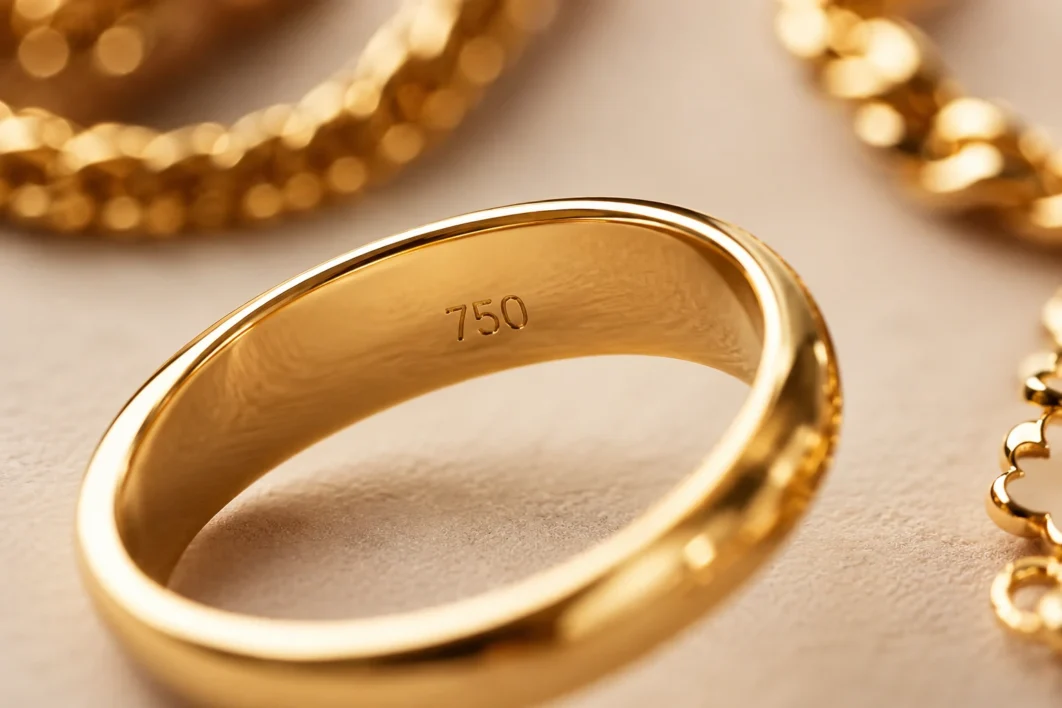
If you’ve ever flipped over a gold ring or bracelet and spotted a tiny “750” stamped somewhere on it, you’re not alone in wondering what it means. What does 750 mean on jewelry? Simply put, the 750 stamp on jewelry tells you the gold purity of that piece. It means the item is made of 18-karat gold, containing 75% pure gold by weight.
Understanding gold purity marks like this one can save you from bad purchases, help you understand what your jewelry is actually worth, and honestly, make you sound impressive at a dinner table.
The Basics: What Is the 750 Hallmark, Exactly?
The number “750” is a hallmark, which is an official mark stamped on precious metal items to certify their purity.
In the metric fineness system used across Europe, Asia, and most of the world, gold purity is measured in parts per thousand. So, 750 means 750 parts out of 1,000 are pure gold. That’s 75% gold content, which is exactly what 18-karat gold represents.
Think of it this way: if your ring weighs 10 grams, 7.5 grams of it is pure gold. The remaining 2.5 grams is an alloy, usually copper, silver, palladium, or zinc, added to improve durability and sometimes adjust the color.
Is 750 Gold Real Gold?
Yes, 750 gold is absolutely real gold. In fact, it’s among the highest-purity gold alloys you’ll regularly find in fine jewelry.
The confusion often comes from people associating “pure gold” with the number 24. Pure gold is 24 karats (999 or 999.9 fineness). But pure gold is also extremely soft. It bends, scratches, and wears down quickly when used in everyday jewelry. That’s why jewelers mix it with other metals to create a harder, more durable product.
At 75% gold purity, 750 gold strikes an excellent balance between purity and wearability. It’s genuine, valuable, and used in high-end jewelry worldwide.



18K Gold vs 750 Gold: Are They the Same Thing?
Yes, 18K gold and 750 gold are exactly the same thing. They just use different naming systems.
The karat system (used mainly in the United States, UK, and Canada) expresses gold purity as a fraction of 24. So 18 karats means 18 out of 24 parts are gold, which equals 75%. The millesimal fineness system (common in Europe, Asia, the Middle East, and international trade) expresses purity in parts per thousand. 75% equals 750 per thousand.
Same gold, two different labels. If you buy an 18K gold ring in New York or a 750-stamped bracelet in Milan, you’re getting the same purity of gold.
Why Is 75% Gold the Sweet Spot for Fine Jewelry?
Jewelers and buyers love 18K/750 gold for a reason. Actually, several reasons.
At 75% purity, the gold content is high enough to retain that rich, warm yellow color that pure gold is known for. Lower-purity alloys, like 10K (41.7% gold) or 14K (58.3% gold), can look slightly more muted or pale in comparison. At the same time, the 25% alloy content gives 750 gold enough strength to hold gemstone settings securely, resist everyday scratches, and maintain its shape over years of wear.
It’s also worth noting that 750 gold is generally hypoallergenic enough for most people with sensitive skin, especially in white gold or yellow gold versions. Rose gold in 750 fineness, which gets its color from copper in the alloy mix, is also widely loved for its warm, pinkish hue.
How to Identify 750 Gold on Your Jewelry
Spotting a 750 stamp is usually straightforward if you know where to look.
On rings, the hallmark is typically stamped on the inner band. On necklaces and bracelets, look near the clasp or on a small tag attached to the chain. On earrings, check the post or the back of the finding. On pendants, the stamp often appears on the bail (the loop that connects to the chain).
The “750” may appear alone, or alongside other marks. You might see it combined with a maker’s mark (the manufacturer’s logo or initials), an assay office mark (used in countries like the UK and Switzerland to show the piece was independently tested), or a year letter in some European systems.
If you’re having trouble reading the stamp because it’s small or worn, a jeweler’s loupe or even a phone camera with zoom can help. Most reputable jewelry stores will also verify marks for you on the spot.

What Other Numbers Might Appear Near the 750 Mark?
Gold jewelry comes in several purity levels, each with its own fineness number.
999 or 999.9 means 24-karat gold, essentially pure gold. It’s used in bullion coins, bars, and some traditional jewelry in countries like India and China. 916 means 22-karat gold (91.6% pure), popular in South Asian bridal jewelry. 750 means 18-karat gold, the standard for fine jewelry globally. 585 means 14-karat gold (58.5% pure), extremely common in American and German jewelry markets. 375 means 9-karat gold (37.5% pure), widely used in the UK and Australia for more affordable pieces.
So if you see a 585 stamp instead of 750, you’re holding 14K gold, not 18K. Both are real gold, but with different purity levels and different price points.
Does the 750 Stamp Affect Gold Value?
Absolutely. Gold purity directly affects the intrinsic metal value of a piece.
The more pure gold a piece contains, the higher its melt value. A 750-stamped piece contains significantly more gold by weight than a 585 or 375 piece of the same total weight. This matters when buying, selling, or appraising jewelry.
That said, the total value of a fine jewelry piece isn’t just about the gold purity. Craftsmanship, brand, gemstones, rarity, and condition all play a role. A Cartier bracelet stamped 750 carries far more market value than a plain gold band with the same stamp, even if both have identical gold content.
For resale or scrap value purposes, however, the 750 stamp is what tells a dealer exactly how much pure gold they’re working with.
Can the 750 Stamp Be Fake?
Unfortunately, yes. While rare with reputable jewelers, counterfeit hallmarks do exist in unregulated markets.
Some dishonest sellers stamp gold-plated or gold-filled items with a 750 mark to mislead buyers. A gold-plated piece has only a thin layer of gold over a base metal (like brass or copper) and is not worth anywhere near the same as solid 750 gold.
Here are some ways to protect yourself. Always buy from certified or established jewelers. Ask for a certificate of authenticity or a jeweler’s appraisal. Look for additional hallmarks, like an assay office mark, which adds a layer of independent verification. You can also request an acid test or XRF (X-ray fluorescence) test if you’re purchasing a high-value piece from an unfamiliar source.
A magnet test is a quick but limited check. Real gold doesn’t stick to a magnet. But keep in mind that some non-gold alloys are also non-magnetic, so this test alone doesn’t confirm authenticity.
How Does the 750 Mark Compare in Different Countries?
The 750 hallmark is recognized and used internationally, but different countries add their own verification systems on top of it.
In Switzerland, luxury watchmakers like Rolex, Patek Philippe, and Audemars Piguet routinely use 750 gold in their cases and bracelets. The Swiss Federal Institute of Metrology oversees precious metal controls in the country. In the United Kingdom, pieces must pass through an official assay office (London, Birmingham, Edinburgh, or Sheffield) where they’re independently tested. A UK hallmark on an 18K piece includes the millesimal fineness mark (750), an assay office symbol, and a maker’s mark. In Italy, which is one of the world’s largest jewelry manufacturing hubs, 750 is the dominant gold standard for export quality pieces. You’ll see it stamped alongside a star and numerical code identifying the manufacturer.
In the United States, there’s no mandatory independent hallmarking system, but the FTC requires that karat markings (like “18K”) are accurate when used.
What Does 750 Gold Look Like Compared to Other Gold Purity Levels?
Color is one of the first things you notice about gold jewelry, and purity plays a role in it.
Pure 24K gold has a deep, rich yellow color. As you add alloy metals, the color can shift depending on what’s being added. Yellow 750 gold retains a strong golden hue, though very slightly less vivid than 24K. White 750 gold gets its silvery appearance from palladium or nickel in the alloy mix, and is often rhodium-plated for extra brightness. Rose 750 gold gets its blush tone from a higher proportion of copper in the alloy.
Compared to 14K or 10K yellow gold, 18K/750 yellow gold typically appears noticeably warmer and more intensely gold-colored. If color richness matters to you, 750 gold delivers it better than lower-purity alloys.
Is 750 Gold Worth Buying?
For anyone who values quality, longevity, and genuine precious metal content, 750 gold is an excellent choice.
It’s the standard used by most prestigious jewelry houses globally, from Tiffany and Cartier to Van Cleef and Bvlgari. It’s durable enough for daily wear yet pure enough to hold its color and value over time. It’s also a recognized standard in global gold markets, making it easy to have valued or sold anywhere in the world.
The only trade-off is cost. Because of its higher gold content, 750 gold costs more per gram than 14K or 10K pieces. But for heirloom pieces, engagement rings, or any jewelry meant to last a lifetime, that premium is usually worth it.
Frequently Asked Questions
What does 750 mean on jewelry?
750 on jewelry means the piece is made of 18-karat gold, containing 75% pure gold by weight. The number comes from the millesimal fineness system, where gold purity is measured in parts per thousand. It is one of the most widely used gold standards in fine jewelry worldwide.
Is 750 gold real gold?
Yes, 750 gold is real gold. The 750 stamp confirms the piece contains 75% genuine gold, with the remaining 25% made up of other metals like copper, silver, or palladium for strength and durability. It is a solid gold alloy, not a coating or plating.
Is 750 gold the same as 18K gold?
Yes, 750 gold and 18K gold are exactly the same. Both refer to a gold alloy with 75% pure gold content. The “18K” label uses the karat system common in the US and UK, while “750” uses the millesimal fineness system common in Europe, Asia, and international markets.
How much is 750 gold worth?
The value of 750 gold depends on the current gold spot price and the weight of the piece. Since it contains 75% pure gold, you multiply the piece’s weight (in troy ounces) by 0.75 and then by the current gold price per troy ounce to calculate the raw metal value.
Where is the 750 stamp located on jewelry?
On rings, the 750 stamp is usually inside the band. On necklaces and bracelets, check near the clasp or on a small attached tag. On earrings, look at the post or back finding. On pendants, check the bail. The stamp is designed to be discreet but always present on genuine pieces.
Can a 750 gold stamp be fake?
Yes, fake 750 stamps exist, particularly in unregulated markets. Some sellers apply the stamp to gold-plated or gold-filled items to mislead buyers. To verify authenticity, look for additional hallmarks like an assay office mark, request an acid test or XRF test, and always buy from a certified jeweler.
What is the difference between 750 gold and 585 gold?
750 gold is 18-karat gold with 75% pure gold, while 585 gold is 14-karat gold with 58.5% pure gold. The 750 piece has higher gold content, a richer yellow color, and greater intrinsic value. The 585 piece is slightly more durable due to its higher alloy content and is generally less expensive.
What does AU 750 mean on jewelry?
AU 750 combines the chemical symbol for gold (Au, from the Latin “aurum”) with the millesimal fineness number. It means the piece is 18-karat gold with 75% pure gold content. Some European and luxury manufacturers use AU 750 as a combined hallmark. It carries the same meaning as a plain 750 stamp.
Can you shower or swim with 750 gold jewelry?
Occasional exposure to water will not immediately damage 750 gold, but regular contact with shampoo, soap, chlorine, and saltwater can dull the surface and weaken delicate settings over time. It is recommended to remove 750 gold jewelry before showering, swimming, or using cleaning products to maintain its appearance.
Is 750 gold better than 14K gold?
750 gold (18K) has higher gold purity at 75% compared to 14K gold at 58.5%, making it more valuable and richer in color. However, 14K gold is slightly harder and more resistant to everyday scratches due to its higher alloy content. For luxury and heirloom jewelry, 750 gold is generally the preferred choice.
Gold Purity Marks Explained: A Quick Summary
Understanding gold purity marks is genuinely useful whether you’re a buyer, a seller, or just someone who found an old bracelet in a drawer and wants to know what it’s worth.
The 750 stamp on jewelry tells you one clear fact: the piece is 18-karat gold with 75% gold purity. It’s real, it’s valuable, and it’s among the most widely used gold standards in the world of fine jewelry. Whether the number appears as “750,” “18K,” or “18ct,” the gold inside is the same.
Next time you see that tiny stamp, you’ll know exactly what you’re looking at, and you’ll probably find yourself explaining it to someone else before long.