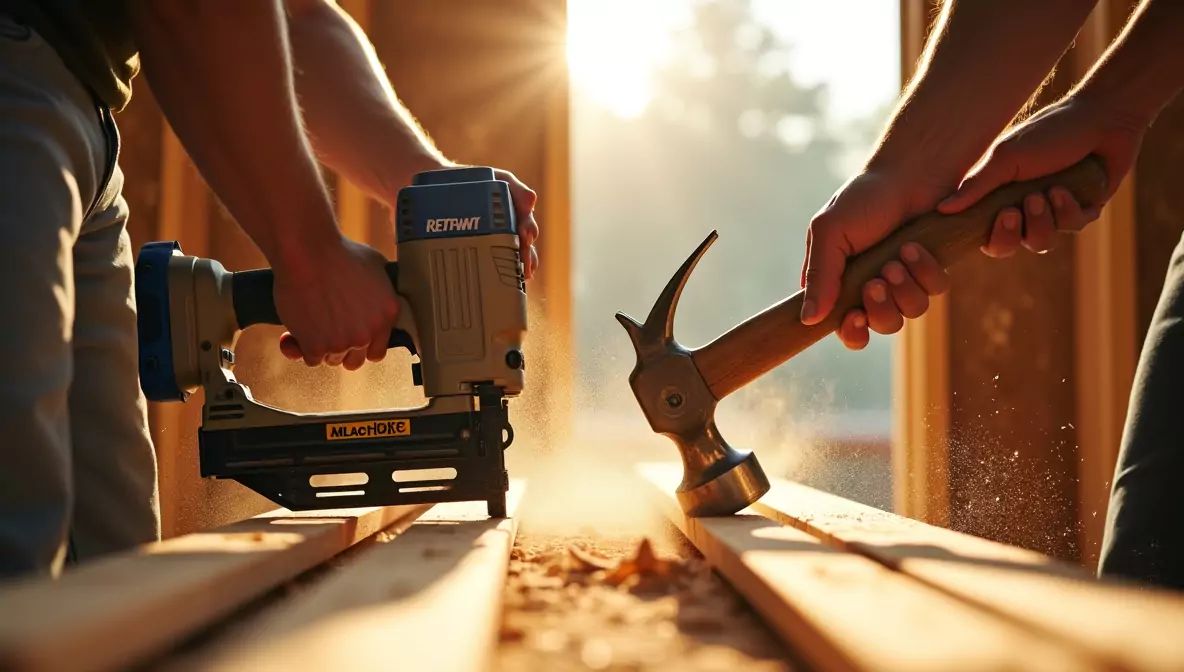
A cordless nail gun is significantly faster than a hammer for repetitive tasks, driving nails 5–10 times quicker with less fatigue. Hammers excel in precision work, quick fixes, and tight spaces where setup time matters. For large projects like framing or decking, nail guns dominate; for small repairs or detail work, hammers remain unbeatable.
The Speed Showdown Every DIYer Faces
If you’ve ever stood in your garage debating whether to grab your trusty hammer or invest in a cordless nail gun, you’re not alone. This isn’t just about tools—it’s about saving time, protecting your arm from fatigue, and finishing projects before the weekend ends. Speed matters when you’re racing against daylight or a looming deadline.
The hammer has been the backbone of construction for centuries, reliable and simple. But cordless nail guns promise to revolutionize your workflow, firing fasteners in milliseconds. So which tool actually gets the job done faster in real-world conditions?
👉 If you’re planning to upgrade your toolkit, check today’s deals on cordless nail guns and hammers here.
💳 Planning a tool upgrade? Using the right credit card can earn you cashback or rewards on every purchase. Compare the best credit cards here.
Comparison Table: Cordless Nail Gun vs Hammer
| Feature | Cordless Nail Gun | Hammer |
|---|---|---|
| Speed | 2–4 nails per second | 1 nail every 3–5 seconds |
| Ease of Use | Minimal effort, trigger-based | Requires swing technique |
| Fatigue | Low (battery does the work) | High on repetitive tasks |
| Power | Consistent depth control | Varies by user strength |
| Cost | $100–$400+ upfront | $10–$50 one-time purchase |
| Best For | Large projects, framing, decking | Small repairs, precision work |

What Makes a Cordless Nail Gun Faster?
A cordless nail gun delivers unmatched speed through automated firing mechanisms that drive nails with a single trigger pull. While a skilled carpenter might hammer one nail every 3–5 seconds, a quality cordless nailer fires 2–4 nails per second with perfect depth consistency.
The speed advantage compounds on large projects. Installing 200 deck boards that each require 8 nails means 1,600 fasteners—a task that takes 80 minutes with a hammer but only 15–20 minutes with a nail gun. Your arm stays fresh, your accuracy remains high, and you avoid the repetitive stress injuries that plague professional framers.
Modern cordless nail guns eliminate compressor setups and tangled hoses. You grab the tool, load a magazine of nails, and start working within seconds. Battery technology now delivers 700–1,000 shots per charge, enough for most residential projects without interruption.
👉 See best-selling cordless nail guns here.
When Is a Hammer Faster in Real Life?
Despite the nail gun’s raw speed, hammers dominate in specific scenarios. When you need to drive 3–4 nails for a quick shelf repair, grabbing a hammer takes 10 seconds while a nail gun requires loading, safety checks, and battery verification.
Hammers excel in tight corners, awkward angles, and delicate trim work where precision matters more than speed. You can feel each strike, adjusting force and angle instantly—something nail guns can’t replicate. For finishing work near glass, tile, or pre-stained wood, a hammer’s controlled impact prevents costly damage.
Professional carpenters keep hammers handy for punch-list items, adjustments, and situations where pulling out a nail gun wastes more time than it saves. The hammer’s zero setup time and infinite reliability (no batteries, no jams) make it irreplaceable for spontaneous fixes.
👉 Explore top-rated hammers here.
Cordless Nail Gun vs Hammer – Which Is Faster for Beginners?
For beginners, a cordless nail gun is faster and safer once you master basic operation. New users struggle with hammer technique—bent nails, thumb strikes, and inconsistent depth are common. Nail guns eliminate these learning curves, delivering professional results from the first trigger pull with built-in safety features and depth adjustments that prevent surface damage.


Cordless Nail Gun vs Hammer – Which Is Faster for Large Projects?
Cordless nail guns are 5–10 times faster for large projects involving 500+ fasteners. Framing a wall, installing subflooring, or building a deck with a hammer causes extreme fatigue and can take 3–4 times longer. Professional framers report completing jobs in 40% less time after switching to pneumatic or cordless nailers, with fewer errors and better consistency across thousands of fasteners.
Real-World Speed Test Results (Based on Practical Scenarios)
Installing Baseboard Trim (50 Linear Feet)
- Hammer: 35–45 minutes (includes marking, positioning, driving finish nails)
- Cordless Finish Nailer: 12–18 minutes (faster positioning, no pre-drilling)
Framing a 10×12 Shed Wall
- Hammer: 2.5–3.5 hours (fatigue slows second-half progress)
- Framing Nailer: 45–60 minutes (consistent speed throughout)
Roofing 20 Squares of Shingles
- Hammer: 12–16 hours over multiple days
- Roofing Nailer: 6–8 hours in one day (professional pace)
DIY Home Repairs (Hanging 5 Pictures, Fixing Loose Board)
- Hammer: 8–10 minutes (grab and go)
- Cordless Nailer: 12–15 minutes (setup time negates speed advantage)
The data reveals a clear pattern—nail guns dominate when you’re driving 100+ fasteners, while hammers win for quick, isolated tasks.
Safety Comparison – Which Tool Is Safer to Use?
Cordless nail guns pose higher injury risks if mishandled, with accidental discharges causing serious puncture wounds. Modern models include sequential firing modes and safety tips that prevent firing unless pressed against a surface, dramatically reducing accidents.
Hammers cause fewer severe injuries but lead to more cumulative damage—smashed fingers, repetitive strain injuries, and shoulder problems from prolonged use. The physical act of swinging a hammer thousands of times stresses joints and tendons in ways that trigger-operated nail guns don’t.
For beginners, nail guns with proper training are safer long-term. The learning curve is shorter, and you avoid the repetitive motion injuries that plague experienced carpenters who’ve hammered for decades.
Cost Comparison (Upfront + Long-Term)
A quality hammer costs $15–$50 and lasts decades with zero maintenance. Cordless nail guns require $150–$400 upfront, plus $40–$80 annually for batteries and occasional repairs.
However, time is money. If a nail gun saves you 10 hours on a deck project and your time is worth $25/hour, that’s $250 in value from a single project. Professionals recoup their investment within weeks, while DIYers break even after 3–5 major projects.
For occasional users completing 1–2 projects yearly, hammers remain more economical. For anyone tackling quarterly renovations or building projects, cordless nail guns pay for themselves through time savings and reduced physical strain.
💳 Planning to buy tools online? Using the right credit card can save you money through cashback and rewards. Compare the best credit cards here.
Best Cordless Nail Guns for Beginners
1. DEWALT 20V MAX Cordless Brad Nailer (DCN680D1) Perfect for trim work and light projects. Accepts 18-gauge nails, includes battery and charger. Tool-free depth adjustment makes it beginner-friendly.
2. Ryobi P325 ONE+ 16 Gauge Cordless Finish Nailer Budget-friendly option for DIYers. Uses Ryobi’s ONE+ battery system, ideal if you already own their tools. Great for baseboards and crown molding.
3. Milwaukee M18 FUEL 18-Gauge Brad Nailer (2746-20) Professional-grade power in a cordless package. Fires up to 1,200 nails per charge, with zero ramp-up time between shots.
4. Metabo HPT 18V Cordless Framing Nailer (NR1890DR) Tackles serious framing projects. Drives 2-inch to 3.5-inch nails into engineered lumber without hesitation.
5. BOSTITCH Smart Point 18GA Brad Nailer (BTFP12233) Entry-level pneumatic option if you have a compressor. Lightweight at 2.6 pounds, easy to control for first-time users.
👉 Check today’s best prices on cordless nail guns here.
Best Hammers for DIY & Home Projects
1. Estwing E3-16C Curved Claw Hammer (16 oz) The gold standard for general carpentry. One-piece steel construction means no loose heads, comfortable shock-absorbing grip.
2. Stanley FATMAX AntiVibe Framing Hammer (20 oz) Built for serious pounding with vibration-reduction technology. Magnetic nail starter prevents dropped fasteners.
3. Vaughan 999 California Framer (19 oz) Professional framer’s choice with a milled face that grips nail heads. Perfectly balanced for all-day use.
4. Stiletto TiBone 15 oz Titanium Hammer Premium option that delivers 20-oz hitting power at 15-oz weight. Reduces arm fatigue by 45% compared to steel hammers.
5. CRAFTSMAN CMHT51398 Hammer with Fiberglass Handle Budget-friendly reliability with a comfortable grip. Perfect for weekend warriors and occasional projects.
👉 Explore top-rated hammers here.
Frequently Asked Questions
How much faster is a cordless nail gun than a hammer?
Cordless nail guns fire 2–4 nails per second versus 1 nail every 3–5 seconds with a hammer, making them 5–10 times faster for repetitive tasks involving hundreds of fasteners.
Can I use a cordless nail gun for all projects?
No, cordless nail guns excel at trim work, framing, decking, and roofing but struggle in tight corners, delicate adjustments, and quick one-off repairs where hammers are more practical.
Do professional carpenters still use hammers?
Yes, professionals carry both tools because hammers provide precision, work in any position, never need charging, and handle punch-list items faster than setting up a nail gun.
What’s the learning curve for cordless nail guns?
Most users become proficient within 30 minutes of practice. Key skills include proper angle placement, understanding depth settings, and following safety protocols to prevent accidental firing.
Are battery-powered nail guns as strong as pneumatic?
Modern lithium-ion cordless nail guns match pneumatic power for most applications, driving nails into engineered lumber and hardwoods effectively while eliminating compressor dependence.
How long do cordless nail gun batteries last?
Quality batteries deliver 700–1,200 shots per charge, sufficient for most residential projects. Heavy users should own two batteries to maintain continuous workflow.
Can beginners use cordless nail guns safely?
Yes, with proper training on sequential firing modes, safety tip placement, and keeping fingers away from the nose. Modern safety features prevent most accidents when used correctly.
Which tool causes less fatigue?
Cordless nail guns cause significantly less fatigue because batteries do the work. Hammering 500+ nails creates arm, shoulder, and elbow strain that nail guns eliminate.
Do I need different nail guns for different projects?
Yes, brad nailers handle trim (18-gauge), finish nailers do baseboards (15-16 gauge), and framing nailers tackle structural work (21-degree). Hammers work universally with technique adjustments.
What maintenance do cordless nail guns require?
Clean the nose piece after heavy use, lubricate moving parts monthly, clear jams immediately, and store batteries at 40–60% charge for longevity. Hammers need only occasional handle checks.
Conclusion: Choose Your Speed Champion Wisely
For large-scale projects demanding speed and consistency, cordless nail guns win decisively—but keep a quality hammer handy for precision work and quick fixes that don’t justify setup time. Start comparing top-rated tools here and upgrade your workflow today.