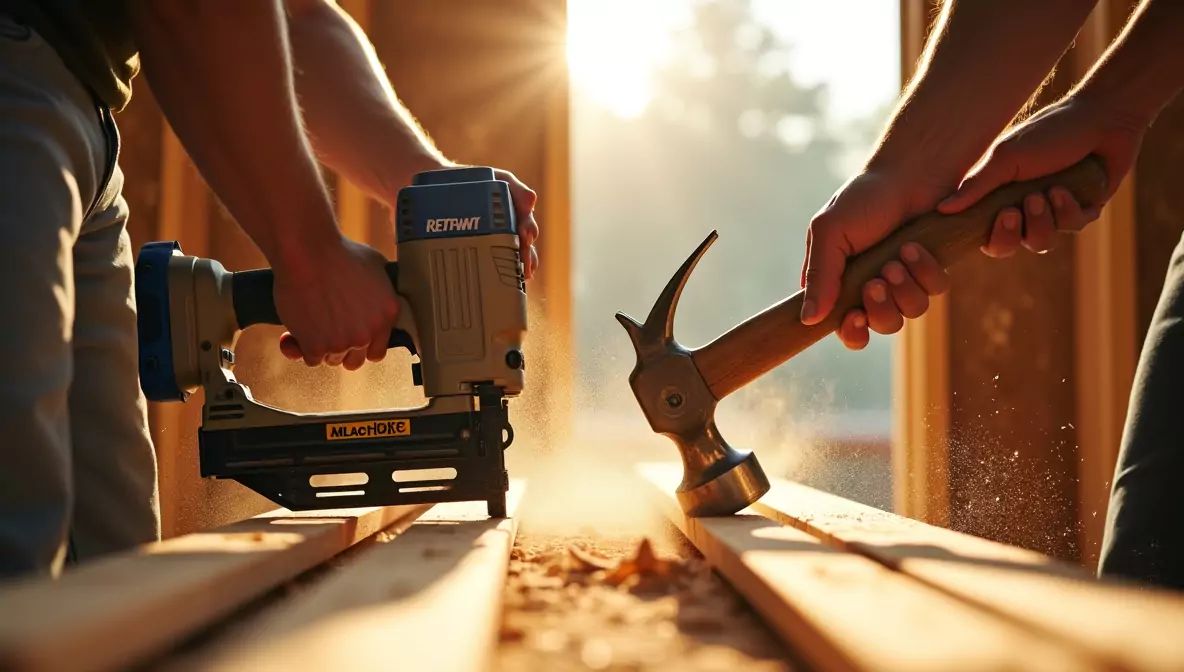
Anyone who has ever built a shelf, repaired furniture, or framed a wall has faced the same question: should you use a hammer or a cordless nail gun?
For decades, the hammer ruled every toolbox. It is simple, reliable, and requires no batteries. But cordless nail guns have changed the game. Modern builders and DIYers now use them for speed, precision, and convenience.
Still, that does not mean the hammer is obsolete.
Both tools have their place. The right choice depends on the project, skill level, and how often you work with wood.
In this guide, we will break down the cordless nail gun vs hammer debate with real logic, practical examples, and honest comparisons. By the end, you will clearly understand which tool suits your work best.
Understanding the Basic Difference
Before comparing performance, it helps to understand how each tool works.
What Is a Hammer?
A hammer is one of the oldest hand tools used in woodworking and construction. It drives nails by force from the user’s swing.
Most carpenters use a claw hammer, which has two sides:
- A flat face to drive nails
- A curved claw to remove them
Hammers work without electricity, batteries, or cartridges. That simplicity makes them dependable in almost any situation.
However, using a hammer requires skill, accuracy, and physical effort.
What Is a Cordless Nail Gun?
A cordless nail gun is a power tool that drives nails automatically using a battery-powered mechanism.
Instead of swinging your arm repeatedly, the tool pushes nails into wood when you pull the trigger.
Most cordless nail guns rely on one of these systems:
- Battery-powered flywheel systems
- Gas cartridge and battery combinations
- Brushless motor drive mechanisms
Manufacturers design them for framing, finish work, trim installation, and woodworking projects.
The biggest advantage? Speed.
Cordless Nail Gun Benefits
Cordless nail guns have gained massive popularity in construction and woodworking. They solve several problems that traditional hammering creates.
Here are the most important cordless nail gun benefits.
1. Much Faster Nailing
Speed is the biggest advantage.
Driving a nail with a hammer usually takes two to four strikes. In contrast, a nail gun drives a nail in one trigger pull.
For projects like framing walls or installing decking, this difference becomes huge.
Professional contractors often say nail guns can make work three to four times faster compared to hammering.
That efficiency explains why nail guns dominate modern construction sites.
2. Less Physical Strain
Hammering hundreds of nails stresses your wrist, elbow, and shoulder.
DIYers often feel fatigue after just a few hours of work.
A cordless nail gun removes most of that strain. You simply position the tool and pull the trigger.
Less strain also reduces the risk of repetitive motion injuries.
3. More Consistent Results
Even skilled carpenters sometimes bend nails with a hammer.
Nail guns drive nails straight and flush into the wood surface. This consistency improves the final look of trim work, cabinetry, and furniture projects.
That precision makes them ideal for cordless nail gun for woodworking applications.
4. Excellent for Large Projects
Large projects demand efficiency.
Building decks, fences, or framed walls involves hundreds or even thousands of nails.
Using a hammer can turn a weekend project into a multi-day job. A nail gun significantly shortens that timeline.


Why People Still Use Hammers
Despite modern power tools, hammers remain essential in woodworking and construction.
Many professionals still carry one on their belt.
Here is why.
1. Absolute Reliability
A hammer never runs out of battery.
It does not jam, misfire, or require maintenance.
Even in remote job sites without electricity, a hammer works perfectly.
That reliability makes it a trusted tool for quick fixes.
2. Better Control for Small Tasks
Some projects require precision that power tools cannot easily provide.
For example:
- Installing delicate trim pieces
- Working in tight spaces
- Fixing loose boards
A hammer gives you better tactile control in these situations.
3. Lower Cost
A high-quality hammer costs far less than a cordless nail gun.
Most homeowners can buy a durable hammer for the price of a few boxes of nails.
In contrast, cordless nail guns can cost several hundred dollars depending on the model.
For occasional DIY tasks, many people prefer the cheaper option.
Hammer vs Nail Gun Comparison
Let’s look at a practical hammer vs nail gun comparison across the factors that matter most.
Speed
Cordless nail guns clearly win.
Driving a nail with a hammer takes several strikes. A nail gun does it instantly.
For construction tasks like framing, roofing, or decking, the speed advantage is massive.
Accuracy
Both tools can deliver good accuracy, but they achieve it differently.
A hammer relies entirely on the user’s skill. Beginners often bend nails or hit the wood surface accidentally.
A nail gun reduces these mistakes because the tool guides the nail directly.
Cost
Hammers win this category easily.
- Hammer: low cost
- Cordless nail gun: higher upfront investment
However, professionals often justify the cost because nail guns save significant time.
Maintenance
Hammers require almost no maintenance.
Cordless nail guns require:
- Battery charging
- Occasional cleaning
- Nail magazine checks
Still, modern nail guns have become more reliable than earlier designs.
Portability
Cordless nail guns are portable but heavier.
A hammer fits easily in a belt loop or toolbox.
For quick tasks, many people prefer the lighter tool.
Nail Gun vs Hammer Efficiency
Efficiency involves more than just speed.
Let’s examine the nail gun vs hammer efficiency in real-world scenarios.
Construction Framing
Framing requires driving large nails repeatedly.
A hammer works, but it demands serious effort and time.
A cordless framing nailer allows builders to work much faster while maintaining consistent depth.
That is why most professional framing crews rely on nail guns.
Furniture and Woodworking
Woodworking projects often involve precision.
Both tools work well depending on the task.
For delicate joints or light nailing, many woodworkers still use a hammer.
However, modern cordless nail gun for woodworking tasks such as cabinet backs, trim pieces, and paneling.
Home DIY Projects
DIYers benefit greatly from cordless nail guns.
Projects like:
- Installing baseboards
- Building shelves
- Assembling wooden frames
become easier and faster.
Many homeowners now look for the best cordless nail gun for DIY projects because it saves time and effort.
Framing Nailer vs Hammer
Framing is one of the most demanding carpentry tasks.
It involves structural wood pieces that require strong fasteners.
Using a Hammer for Framing
Framing with a hammer is possible but extremely labor-intensive.
Builders must drive thick nails into dense lumber repeatedly.
Even experienced carpenters feel fatigue after hours of work.
Using a Framing Nailer
A cordless framing nailer fires large nails quickly and consistently.
It improves productivity and reduces fatigue.
That is why most construction sites rely on nailers instead of manual hammering.
In the framing nailer vs hammer comparison, the nail gun clearly dominates in speed and productivity.
Why Use a Cordless Nail Gun?
Many DIYers ask an important question: why use a cordless nail gun instead of a hammer?
Here are the most practical reasons.
Convenience
Cordless nail guns eliminate the need for air compressors and hoses.
You can move freely around the workspace.
This mobility makes them ideal for outdoor projects.
Time Savings
Large projects often require hundreds of nails.
A nail gun can complete that work in a fraction of the time.
Professional Results
Nail guns drive nails flush and evenly.
That precision improves the appearance of finished work.
Cordless Nail Gun Advantages
To summarize the benefits, here are the major cordless nail gun advantages:
- Faster nailing
- Reduced physical effort
- Consistent nail depth
- Increased productivity
- Ideal for large construction projects
- Helpful for DIY and woodworking
These advantages explain why cordless nail guns continue gaining popularity.

Nail Gun Safety Tips
Power tools always require caution.
Following proper nail gun safety tips helps prevent accidents.
Keep Your Finger Off the Trigger
Only pull the trigger when the tool contacts the work surface.
This simple habit prevents accidental firing.
Wear Protective Gear
Safety glasses protect your eyes from flying debris.
Gloves also improve grip and control.
Never Point the Tool at Anyone
Even when unloaded, always treat a nail gun as if it could fire.
Safe handling habits reduce risk significantly.
Disconnect the Battery During Maintenance
Always remove the battery before clearing jams or performing maintenance.
This step prevents accidental activation.
Manual Hammer vs Power Nailer: When to Use Each
Both tools have strengths.
Understanding the right situation for each tool improves efficiency and results.
Choose a Hammer When
- The project is small
- You need precise manual control
- Power tools are unnecessary
- Budget matters
Choose a Cordless Nail Gun When
- The project involves many nails
- Speed matters
- You want less physical strain
- You work on construction or framing
In the manual hammer vs power nailer debate, the best tool depends on the scale of your work.
Best Cordless Nail Gun for DIY Projects
DIY users should focus on tools that balance performance and ease of use.
Look for these features:
- Lightweight design
- Long battery life
- Easy jam clearing
- Adjustable nail depth
These features make a cordless nail gun beginner-friendly while still powerful enough for home projects.
FAQs
Is a nail gun better than a hammer?
A nail gun is usually faster and requires less physical effort, making it ideal for large projects like framing, decking, or roofing. A hammer works better for small tasks, delicate woodworking, and situations where precise manual control is needed.
When should you use a hammer instead of a nail gun?
You should use a hammer for small repairs, light woodworking, and projects that require precise nail placement. Hammers also work better when you only need to drive a few nails and do not want to set up power tools.
Are cordless nail guns worth it for DIY projects?
Yes, cordless nail guns can be very helpful for DIY projects like installing trim, building shelves, or assembling furniture. They reduce effort and allow you to drive nails quickly without using compressors or hoses.
Do professionals still use hammers?
Yes, professionals still use hammers for quick fixes, adjustments, and tasks that require manual control. Even on modern construction sites, carpenters often carry a hammer alongside power tools.
Is a nail gun faster than a hammer?
Yes. Nail guns drive nails instantly with a trigger pull, while a hammer usually requires multiple strikes to drive a single nail. This makes nail guns significantly faster for repetitive work.
Can a nail gun split wood?
Yes, a nail gun can split soft or thin wood if the pressure is too high or the nail is placed near the edge. Adjusting nail depth and using the correct nail size can reduce this risk.
What is the main advantage of a cordless nail gun?
The biggest advantage is speed and reduced physical strain. A cordless nail gun drives nails quickly and consistently without repeated hammer swings.
Which tool is cheaper: hammer or nail gun?
A hammer is much cheaper. Most hammers cost under $50, while nail guns can cost several hundred dollars depending on the model and features.
Is a nail gun safe for beginners?
Yes, but beginners must follow safety rules. Wearing eye protection, keeping fingers away from the trigger, and disconnecting the battery during maintenance are essential safety practices.
What type of nail gun is best for woodworking?
Finish nailers and brad nailers are commonly used for woodworking because they drive smaller nails that are less likely to split delicate wood pieces.
Final Verdict: Cordless Nail Gun vs Hammer
The cordless nail gun vs hammer debate does not have a single universal winner.
Each tool serves a different purpose.
A hammer remains one of the most reliable tools ever made. It works anywhere, costs little, and handles small tasks perfectly.
Cordless nail guns, however, bring speed, efficiency, and convenience. They shine in large projects where driving hundreds of nails quickly matters.
For occasional repairs or simple woodworking, a hammer works well.
For construction, framing, or large DIY builds, a cordless nail gun often becomes the smarter choice.
In many workshops, the best solution is simple.
Use both.
A hammer handles quick fixes and precision work, while a cordless nail gun powers through large tasks with speed and consistency.
That combination gives builders the flexibility to tackle any project efficiently.