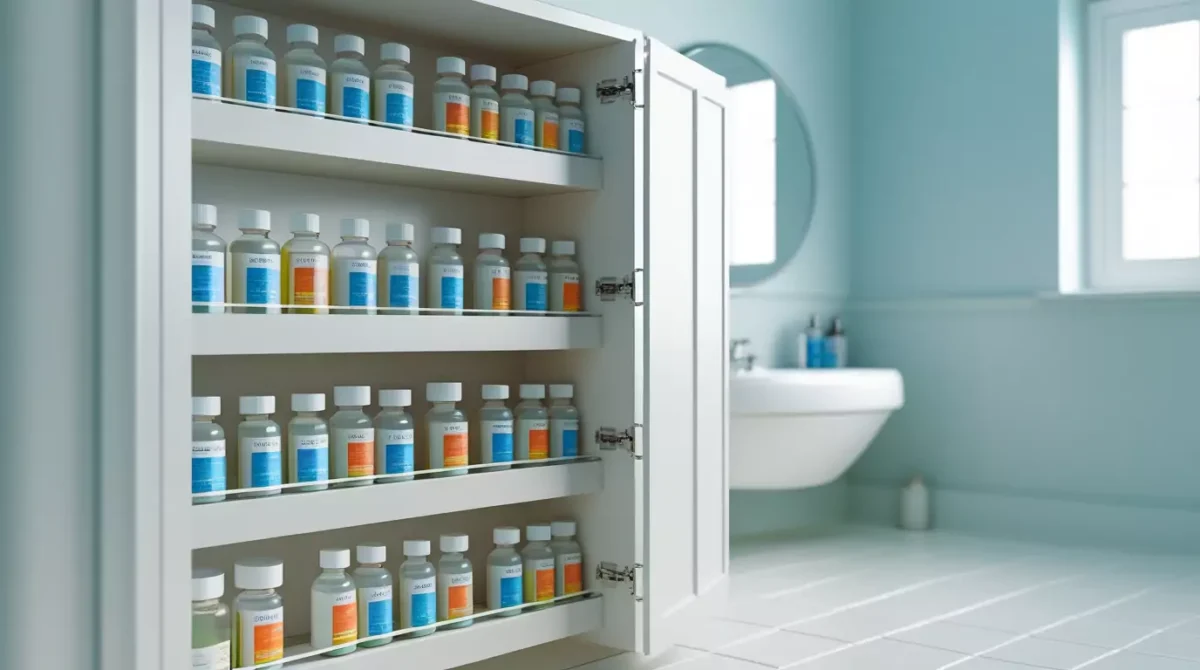
Let me guess.
You opened your medicine cabinet yesterday looking for paracetamol and found a bottle of cough syrup from 2019.
Sound familiar?
I’ve been there.
Standing in my bathroom at 2am with a splitting headache, digging through expired vitamins and mystery tubes that could be either toothpaste or antifungal cream.
Not ideal.
Here’s the thing about medicine cabinet organisation – most people do it backwards.
They organise by medicine type. They organise by family member. They organise by frequency of use.
But none of that matters if half your medicines are past their sell-by date.
Why Medicine Cabinet Expiration Dates Actually Matter
Let me tell you what happened to my mate Sarah last month.
She grabbed what she thought was fresh ibuprofen for her back pain. Turned out it was three years expired. Did nothing for the pain. Wasted an entire evening lying on the sofa when she could’ve been sorted in 30 minutes with proper medication.
Here’s what expired medicines actually do:
- Lose potency (sometimes completely)
- Change chemical composition
- Become less effective or completely useless
- In rare cases, become harmful
The FDA says most medicines are safe past expiration but less effective.
That’s not good enough for me.
When I need medicine, I need it to work.
The Simple System I Use to Organize My Medicine Cabinet by Expiration Dates
Forget complicated systems.
This takes 20 minutes twice a year.
Step 1: The Great Medicine Cabinet Purge
Empty everything. Every single item. Place it all on your bathroom counter.
Check each item for:
- Expiration dates
- Damaged packaging
- Changed colour or smell
- Crusty lids or leaked contents
Bin anything that’s:
- Expired by more than 6 months
- Damaged
- Prescription medicines from old illnesses
- Vitamins that smell like fish (unless they’re supposed to)
Step 2: The Front-to-Back Rotation Method
This is restaurant-level organisation.
The rule: Newest items go to the back, oldest go to the front.
Just like how supermarkets stock their shelves.
Here’s exactly how I arrange mine:
- Front row: Items expiring in the next 6 months
- Middle row: Items expiring in 6-12 months
- Back row: Items with 12+ months remaining
Stick a small label on the front of each shelf with the expiration range.
Makes restocking dead simple.
Step 3: Create Expiration Date Zones
I divide my medicine cabinet into three zones:
Zone 1 – Use First (Front)
- Medicines expiring within 6 months
- Open bottles or tubes
- Items you use regularly
Zone 2 – Standard Stock (Middle)
- Medicines with 6-12 months left
- Backup supplies
- Seasonal medications
Zone 3 – Long-term Storage (Back)
- New purchases
- Items with 12+ months remaining
- Emergency supplies
Step 4: The Monthly 5-Minute Check
First Sunday of every month. Set a phone reminder.
Quick scan checklist:
- Move items from back zones forward as dates approach
- Check for any newly expired items
- Note what needs restocking
That’s it.


Smart Storage Tips That Actually Work
Use clear containers with dates written on top You can see everything at a glance. No more mystery bottles hiding behind other bottles.
Keep a medicine inventory list Stick it inside the cabinet door. Include item name, expiration date, and quantity. Update it when you restock.
Store medicines in original packaging I know those fancy pill organisers look neat. But original packaging has the expiration date and dosage information. Keep it.
Group by expiration timeline, not by type Don’t put all the painkillers together. Put the soon-to-expire painkillers with other soon-to-expire items.
What to Do With Expired Medicines
Don’t flush them down the toilet. Don’t bin them with regular rubbish.
Most pharmacies have take-back programmes. Some police stations do too.
Call ahead and ask.
For controlled substances (prescription painkillers, etc.), many areas have specific drop-off days.
Check your local council website.
Common Medicine Cabinet Organisation Mistakes
Mistake 1: Storing everything together Pain relief from 2020 mixed with brand-new vitamins. Recipe for confusion.
Mistake 2: Not checking dates when restocking You buy new paracetamol and shove it wherever there’s space. Meanwhile, the old bottle sits unused until it expires.
Mistake 3: Keeping prescription medicines “just in case” That leftover antibiotic from your chest infection? Bin it. Taking incomplete courses or old antibiotics is dangerous.
Mistake 4: Ignoring storage conditions Some medicines need cool, dry storage. Your steamy bathroom might not be ideal for everything.



Quick Reference: How Long Common Medicines Last
Over-the-counter medicines:
- Paracetamol/Ibuprofen: 2-3 years
- Cough syrup: 1-2 years
- Antihistamines: 2-3 years
- Topical creams: 1-3 years
Vitamins and supplements:
- Tablets: 2-3 years
- Gummies: 1-2 years
- Liquid vitamins: 1-2 years
First aid supplies:
- Plasters: 3-5 years
- Antiseptic wipes: 2-3 years
- Thermometers: Check manufacturer guidelines
The Psychology Behind Good Medicine Organisation
Here’s something nobody talks about.
Good organisation reduces decision fatigue.
When you’re ill, the last thing you want is to stand there reading tiny expiration dates on 15 different bottles.
You want to grab what you need and get back to bed.
A well-organised medicine cabinet organised by expiration dates makes this possible.
It also prevents:
- Panic buying during illness
- Wasting money on medicines you already have
- Taking ineffective expired medicines
- Dangerous mix-ups with old prescriptions
Setting Up Your Medicine Cabinet Restocking System
Monthly check routine:
- First Sunday: Quick expiration scan
- Make note of items expiring within 3 months
- Add replacements to your shopping list
Quarterly deep clean:
- Empty entire cabinet
- Wipe down shelves
- Check all expiration dates
- Reorganise based on new timeline
Annual audit:
- Review what you actually use vs. what you stock
- Adjust your standard inventory
- Update your emergency medicine kit


Emergency Medicine Kit Integration
Keep a separate emergency kit for power cuts or when you can’t get to the shops.
Basic emergency kit:
- Pain relief (paracetamol/ibuprofen)
- Anti-diarrheal medicine
- Rehydration salts
- Basic first aid supplies
- Thermometer
Check expiration dates every 6 months.
Rotate stock just like your main cabinet.
Frequently Asked Questions (FAQs)
How often should I check expiration dates in my medicine cabinet?
Monthly for a quick scan, quarterly for a deep clean. Set phone reminders to make it automatic.
Is it safe to use medicines slightly past their expiration date?
Most over-the-counter medicines lose potency rather than become dangerous, but I don’t recommend it. When you need medicine to work, you need it to work properly.
Should I organise by medicine type or expiration date?
Expiration date first, then by type within each expiration zone. This prevents you from accidentally using expired medicines.
Where should I store medicines that need to be kept cool?
Not your bathroom if it gets steamy. Consider a bedroom drawer or kitchen cupboard away from heat sources. Some medicines genuinely need refrigeration – follow the label.
How do I remember to rotate stock when I buy new medicines?
Always put new items at the back of each zone. It becomes automatic after a few times, just like loading a dishwasher.
What’s the best way to dispose of expired medicines safely?
Take them to your local pharmacy or check for community take-back days. Never flush medicines or put them in regular household waste.
Final words
Organising your bathroom medicine cabinet by expiration dates isn’t complicated.
It’s just different from what most people do.
Empty everything. Check dates. Arrange from front to back: oldest to newest. Set monthly reminders to rotate stock.
Takes 20 minutes to set up. Saves hours of frustration later.
More importantly, it ensures your medicines actually work when you need them.
Because there’s nothing worse than being ill and discovering all your medicine is expired.
Trust me on this one – proper medicine cabinet organisation by expiration dates is worth every minute you spend setting it up.