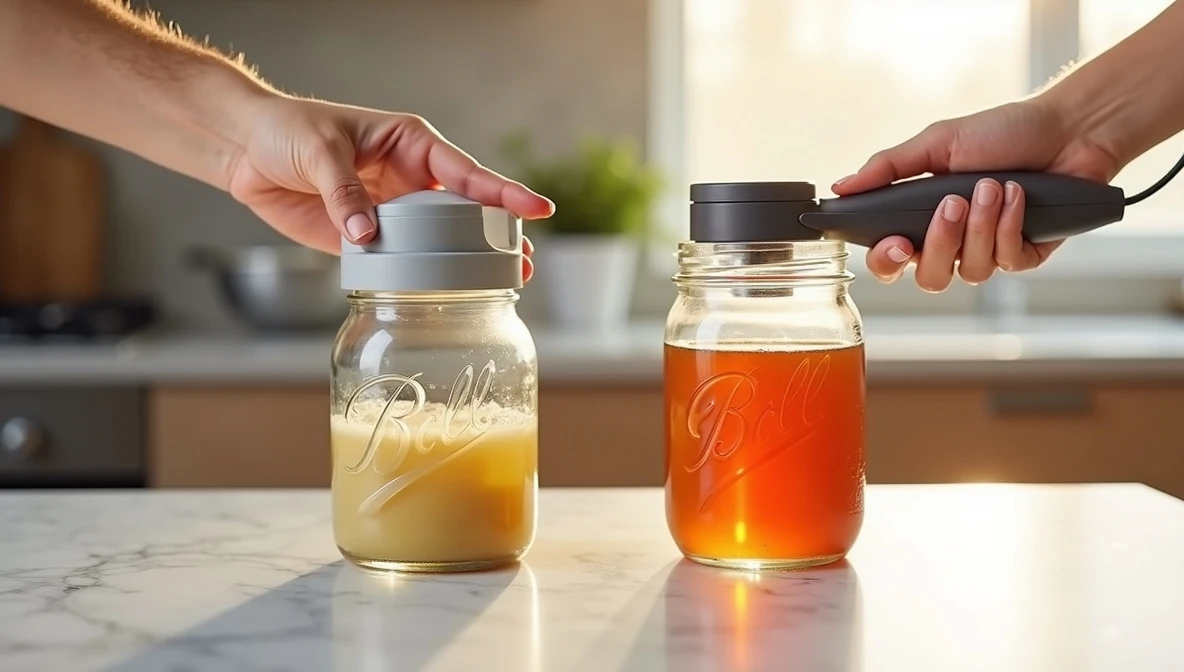
The Great Pickle Jar Standoff
Picture this: It’s 11 PM on a Tuesday. You’re craving a midnight snack, and all you want is a pickle. Just one pickle. But standing between you and that crispy, briny goodness is the most stubborn jar lid known to mankind. You twist. You grunt. You wrap a towel around it. You even try the hot water trick your mom taught you. Nothing. That lid isn’t budging.
Sound familiar?
If you’ve ever found yourself in a wrestling match with a jar lid (and lost), you’re not alone. Whether it’s pasta sauce, pickles, jelly, or that fancy artisan jam you bought at the farmers market, tight jar lids are the universal kitchen enemy. And they always seem to seal themselves extra tight right when you need them most.
Enter the humble jar opener – a kitchen tool that doesn’t get nearly enough credit for the sanity it saves. But here’s where things get interesting: Should you go old-school with a manual jar opener, or embrace modern convenience with an electric one?
That’s exactly what we’re diving into today. No boring textbook explanations here – just real talk about which jar opener actually makes your life easier.
What Exactly is a Jar Opener, Anyway?
Let’s start with the basics. A jar opener is pretty much what it sounds like – a tool designed to help you open stubborn jar lids without turning your hands into cramped, red messes or risking a trip to the ER when that lid finally pops off and sends pickles flying across your kitchen.
But jar openers aren’t just about convenience (though that’s a big part of it). They’re genuinely life-changing for a lot of people.
Think about your grandma who has arthritis in her hands. Or your neighbor recovering from carpal tunnel surgery. Or even just busy parents trying to make lunch for three kids while simultaneously answering work emails. These folks aren’t just looking for a shortcut – they need a tool that actually works when their hands can’t do the job safely or comfortably.
Jar openers serve everyone from:
- Elderly folks who’ve lost some grip strength over the years
- People dealing with arthritis, carpal tunnel, or other hand conditions
- Anyone recovering from wrist or hand injuries
- Kids who want to help in the kitchen but can’t quite master the twist yet
- Perfectly healthy people who just grabbed the one jar in the pantry with the lid from hell
The goal is simple: make opening jars easier, safer, and less frustrating. How you get there – manual or electric – well, that’s what we’re here to figure out.



Manual Jar Openers: The Classic Approach
Manual jar openers have been around forever, and for good reason. They’re the reliable workhorses of the kitchen drawer, sitting there quietly until you need them.
How They Work
The basic concept is pretty straightforward: manual jar openers give you better leverage and grip than your bare hands can manage. Some grab the lid, some stabilize the jar, and some do both. You still supply the twisting power, but the tool makes it way easier.
Types of Manual Jar Openers
Basic Grip Pads
These are those rubber or silicone sheets that look almost too simple to work. You place one on the lid, grip, and twist. They’re like $3 at any grocery store, and honestly? They work pretty well for moderately stuck lids. I keep one in my drawer and use it way more than I expected.
Adjustable Clamp-Style Openers
These look like little handheld gadgets with adjustable teeth or grips. You adjust them to fit your jar size, clamp onto the lid, and twist. They give you serious leverage, which is great when you’re dealing with those really stubborn lids. Check electric jar opener options on Amazon if you want to compare different grip styles.
Under-Cabinet Mounted Openers
These bad boys screw into the underside of your kitchen cabinet and have V-shaped grooves that fit different lid sizes. You stick the jar up into the opener, hold the jar steady, and twist. They’re fantastic if you have the cabinet space and don’t mind the installation. Plus, they’re always there when you need them – no digging through drawers.
Multi-Size Grip Openers
These usually have multiple grooves or teeth designed to grip various lid sizes. They look like colorful plastic contraptions with different sized circles cut into them. Pretty clever design, actually.
The Good Stuff About Manual Openers
Let’s talk benefits. Manual jar openers are:
- Crazy affordable – Most cost between $5 and $20. Even the fancy ones won’t break the bank.
- Always ready – No batteries to die. No cords to plug in. Just grab and go.
- Portable – Toss one in your bag when you’re heading to a friend’s house for dinner or going camping.
- Long-lasting – Without electronic components, there’s not much that can break. I’ve had the same rubber gripper for years.
- Zero learning curve – Even if you’ve never used one before, you’ll figure it out in about five seconds.
I’ll never forget watching my dad struggle with a jar of spaghetti sauce at our family cabin. He tried everything – tapping the lid, running it under hot water, even whacking it with a spoon (which I don’t recommend, by the way). Finally, my aunt handed him a simple rubber grip pad. Two seconds later, pop! That sauce was open. He looked at that little rubber sheet like it was some kind of sorcery.
The Not-So-Great Stuff
But manual openers aren’t perfect. Here’s where they fall short:
- You still need some hand strength – If your hands are really weak or painful, even with help, twisting can be tough.
- Slippery situations – If the jar or your hands are wet or greasy, you’re still going to struggle.
- Not always one-handed – Most require you to hold the jar and operate the opener simultaneously.
- Trial and error – Sometimes you need to try different sizes or positions to get a good grip.
For someone with severe arthritis or limited mobility, manual openers can help, but they might not be enough.
Electric Jar Openers: Welcome to the Future
Now we’re getting fancy. Electric jar openers are the tech-forward solution to the jar problem, and they’ve come a long way in recent years.
How They Work
Electric jar openers do the heavy lifting for you – literally. You position the jar, press a button, and the opener grips the lid and twists it off automatically. Some use motorized clamps, others have rotating mechanisms. The point is, your hands barely have to do anything except hold the jar steady (and some don’t even require that).
Types of Electric Jar Openers
Countertop Electric Openers
These are the most common type. They sit on your counter, plugged into an outlet or powered by batteries. You place the jar in the device, sometimes secure it with a clamp or holder, press a button, and watch the magic happen. They typically work on a range of jar sizes and handle even the most stubborn lids with ease.
Battery-Operated Handheld Twist Openers
These look more like handheld power tools for your kitchen. They’re compact, battery-powered, and you hold them against the jar lid while they do the twisting. They’re more portable than countertop models but might not have quite as much torque for super-stuck lids.
The Good Stuff About Electric Openers
Electric jar openers shine in several areas:
- Truly hands-free operation – Minimal grip strength needed. You’re not doing the twisting, the motor is.
- Perfect for arthritis sufferers – This is where electric openers really prove their worth. When gripping and twisting cause pain, having a tool that eliminates both is a game-changer.
- Consistent performance – They apply even, steady pressure. No jerky movements or sudden slips.
- Great for kids and elderly – Anyone who can press a button can use one safely.
- Multiple jar sizes – Most electric models adjust automatically to different lid sizes.
My neighbor, Mrs. Patterson, is in her late 70s and lives alone. She’s fiercely independent and loves cooking her own meals, but arthritis in her hands had made opening jars nearly impossible. Her daughter got her an electric jar opener last year, and it’s honestly changed her daily routine. She told me, “I can finally open my own jelly jar for my morning toast without having to wait for someone to visit.” That kind of independence? Priceless. See the latest manual jar opener deals here to compare both types.
The Not-So-Great Stuff
Of course, electric openers have their drawbacks too:
- More expensive – Expect to pay anywhere from $15 to $50 or more.
- Requires power – Whether batteries or an outlet, you need a power source. Dead batteries at the wrong time = frustration.
- Less portable – They’re bulkier and not as easy to toss in a drawer or take with you.
- Potential for malfunction – Motors can fail, batteries can corrode, electronic parts can break.
- Counter space – If you have a tiny kitchen, finding a spot for another gadget can be challenging.
Electric vs Manual: The Ultimate Showdown
Alright, let’s get down to brass tacks. How do these two types of jar openers really compare when you put them head-to-head?
Ease of Use
Manual: Pretty straightforward, but you still need to position it correctly and provide the twisting force. If you have good hand dexterity, no problem. If you don’t, it can still be a challenge.
Electric: Press a button. That’s basically it. Winner for pure ease? Electric, hands down.
Winner: Electric
Speed
Manual: Quick once you’ve got it positioned right – usually just a second or two of twisting.
Electric: Takes a few seconds for the motor to do its thing, but no physical effort from you.
Winner: Tie (both are reasonably fast)
Price
Manual: $5–$20 for most models. Hard to beat that value.
Electric: $15–$50+ depending on features and quality.
Winner: Manual
Durability
Manual: Simple design means fewer things that can break. Can last for years or even decades.
Electric: Motors and electronic components can fail. Batteries need replacing. More potential points of failure.
Winner: Manual
Safety
Manual: Safe, but you can still slip and hurt your hand if you’re twisting hard.
Electric: Very safe – minimal hand involvement means minimal risk of slipping or straining.
Winner: Electric
Best for Elderly Users
Manual: Helpful, but may still require more strength than elderly hands can comfortably provide.
Electric: Designed for low-strength operation. Perfect for seniors.
Winner: Electric
Best for Arthritis Patients
Manual: Better than nothing, but twisting motion can still cause pain.
Electric: Eliminates the painful twisting motion entirely.
Winner: Electric
Best for Families
Manual: Kids can use simple rubber grips with supervision.
Electric: Safe for kids to use (with supervision) and helps teach kitchen independence.
Winner: Tie (both work well)
Best for Small Kitchens
Manual: Takes up minimal drawer or cabinet space.
Electric: Requires counter or cabinet space. Can be bulky.
Winner: Manual
Maintenance
Manual: Wash it occasionally. That’s about it.
Electric: Need to replace batteries, keep the motor housing clean, potentially deal with repairs.
Winner: Manual
Portability
Manual: Toss it in a bag. Take it anywhere.
Electric: Bulkier, needs power source. Not travel-friendly.
Winner: Manual
Quick Comparison Table
| Feature | Manual | Electric |
|---|---|---|
| Price | $5-$20 | $15-$50+ |
| Ease of Use | Moderate | Very Easy |
| Strength Required | Some | Minimal |
| Power Source | None | Batteries/Outlet |
| Portability | Excellent | Limited |
| Durability | Very High | Moderate |
| Best For | Budget, Travel | Arthritis, Elderly |
| Maintenance | Minimal | Moderate |
| Safety | Good | Excellent |
| Space Required | Very Little | Moderate |
So Which One Actually Works Better?
Here’s the honest truth: There’s no universal “better” option. It really depends on who’s using it and what they need.
Go Electric If:
You or someone in your household has arthritis, carpal tunnel, or any condition that makes gripping and twisting painful or impossible. Electric openers are genuinely life-changing for people with limited hand strength or mobility issues. They’re also fantastic for elderly folks living independently – that independence and ability to do things for themselves is worth every penny.
If you have kids who want to help in the kitchen, electric openers let them participate safely without needing a ton of hand strength. And honestly, if you just really hate opening jars and can afford the splurge, an electric opener removes that annoyance from your life completely.
Go Manual If:
You’re working with a tight budget. Manual openers deliver serious bang for your buck. They’re also perfect if you have limited kitchen space and don’t want another gadget taking up real estate on your counter or in your cabinets.
Love camping, RVing, or traveling? Manual openers are portable and don’t need power. They’re also great if you want something simple that will last forever without batteries or motors to worry about. If you have reasonably strong hands and just need a little extra grip occasionally, manual openers will serve you well.
Real-Life Scenarios:
- Grandma with arthritis: Electric all the way.
- College student in a dorm: Manual – cheap, simple, no counter space needed.
- Busy parent with three kids: Electric – one less thing to struggle with during dinner prep.
- Weekend warrior who camps frequently: Manual – no batteries required.
- Person recovering from wrist surgery: Electric – don’t risk re-injury.
- Budget-conscious shopper: Manual – get the job done for under $10.
You might even want both. Keep a manual opener as your everyday tool and an electric one for when your hands are tired or for family members who need the extra help. Browse Amazon for top-rated jar openers to see what fits your needs.
Things to Consider Before Buying
Before you click “add to cart,” think about these factors:
Jar Size Compatibility
Not all openers work with all jar sizes. Check the size range – can it handle tiny jelly jars and giant pickle jars? Some openers are adjustable, others only work with standard lid sizes. If you buy a lot of specialty jars or baby food, make sure your opener can accommodate them.
Grip Quality
For manual openers, grip is everything. Look for rubber or silicone with good texture – smooth materials can still slip. For electric openers, check reviews about how well the clamps or grips actually hold the lid.
Ease of Cleaning
Jar openers can get sticky, greasy, and gross. Can you throw it in the dishwasher? Is it easy to wipe down? Avoid openers with lots of crevices that trap food gunk.
Power Source
For electric openers, decide what works for your kitchen. Battery-operated models are more portable but require battery replacements. Plug-in models need an outlet nearby but never run out of juice at the wrong moment. Some newer models are rechargeable, which is a nice middle ground.
Storage Space
Measure your drawer or cabinet space before buying. Will that electric opener actually fit on your counter, or will it become another appliance you hide in the pantry and never use?
Noise Level
Some electric openers can be surprisingly loud. If you share thin walls with neighbors or have a baby who naps in the next room, this might matter.
Brand Reputation and Reviews
This is where exploring more user-friendly jar openers on Amazon really helps. Real user reviews tell you which products actually work and which ones break after two weeks.
Frequently Asked Questions
Are electric jar openers worth it?
If you have arthritis, weak hands, or physical limitations, absolutely yes. They’re also worth it if you hate struggling with jars and want to eliminate that frustration. For someone with strong hands on a tight budget, probably not necessary – a manual opener will do the job.
Do manual jar openers work for people with arthritis?
They can help, but they’re not ideal. Manual openers reduce the effort needed but don’t eliminate it entirely. For mild arthritis, they might be sufficient. For moderate to severe arthritis, electric openers are a better choice.
What’s the best type of jar opener for seniors?
Electric jar openers are generally best for seniors because they require minimal hand strength and eliminate painful twisting motions. Look for models with simple one-button operation and good stability so they don’t slide around the counter.
Can kids use electric jar openers safely?
Yes, with supervision. Electric openers are actually safer for kids than struggling with manual methods because they eliminate the risk of slipping and jerking motions. Just make sure an adult is present and the child understands how to use it properly.
How much should I spend on a jar opener?
Manual openers: $5-$20 is reasonable. Electric openers: $20-$40 gets you a decent model. You can find cheaper electric openers, but they may not last long. Spending over $50 is usually overkill unless you need commercial-grade durability.
Do rubber grip jar openers actually work?
Yes, surprisingly well for moderately stuck lids. They’re not magic – you still need some hand strength – but they significantly improve your grip. For the $5 price tag, they’re worth keeping in your kitchen drawer.
What if my electric jar opener stops working?
First, check the batteries or power connection. Many “broken” electric openers just need fresh batteries. If it’s truly broken, most aren’t worth repairing – they’re designed to be replaced rather than fixed. This is one downside compared to manual openers.
Can jar openers work on bottles too?
Some can! Many jar openers work on bottle caps and other twist-off lids. Check the product specifications for size compatibility. Bottle openers and jar openers share similar mechanics, so there’s often overlap.

The Final Verdict: What Should You Buy?
Let’s wrap this up with some clear recommendations.
If you’re shopping for yourself or someone else and trying to decide between electric and manual, ask yourself these questions:
- Is hand pain or weakness a factor? If yes, go electric.
- Is budget the main concern? If yes, go manual.
- Is counter space super limited? If yes, lean toward manual.
- Is independence for an elderly person the goal? If yes, invest in electric.
The truth is, both types of jar openers work – they just work better for different people in different situations. There’s no shame in starting with a cheap manual opener and upgrading to electric later if you find you need more help. Plenty of people have both and use them for different purposes.
Whatever you choose, you’re making a smart decision. Jar openers are one of those humble kitchen tools that seem insignificant until you have one. Then you wonder how you ever lived without it. No more fighting with pickle jars at midnight. No more asking neighbors for help. No more running jars under hot water for five minutes and hoping for the best.
Just smooth, easy jar opening whenever you need it.
Ready to make your choice? Explore Amazon’s full selection of jar openers to find the perfect one for your kitchen. Your hands – and your midnight snack cravings – will thank you.
Happy jar opening!