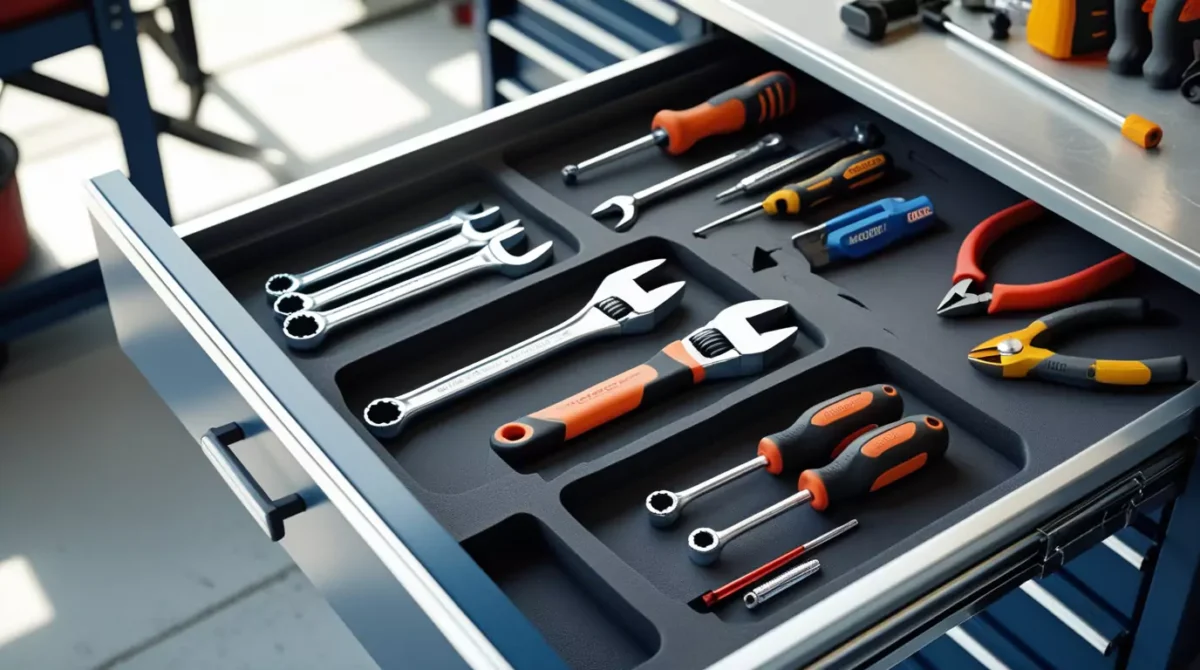
You open your garage drawer and it’s like a tornado hit a hardware store.
Screwdrivers mixed with pliers. Wrenches tangled with wire cutters. And that one socket set that somehow multiplied into chaos.
I’ve been there. Spent 20 minutes looking for a Phillips head screwdriver that was literally right in front of me.
That’s when I discovered foam cutout drawer inserts. Game changer.
Why Your Current Tool Storage Sucks
Most people throw tools in drawers like they’re feeding sharks.
No system. No organization. Just chaos wrapped in metal.
Here’s what happens:
- Tools get damaged from banging against each other
- You waste time hunting for the right tool
- Small pieces disappear into the drawer abyss
- Everything looks like a mess
Sound familiar?
What Are Foam Cutout Drawer Inserts?
Think of foam inserts as custom beds for your tools.
You trace each tool. Cut out the shape. Drop it in your drawer.
Now every tool has its own spot. Like assigned parking for your garage.
The foam is usually:
- Dense enough to hold shape
- Soft enough to protect tools
- Easy to cut with basic tools



The Magic Behind Foam Tool Organization
Here’s what clicked for me.
When every tool has a home, you see what’s missing instantly. Empty spot = missing tool.
It’s visual inventory management. No thinking required.
Plus your tools last longer because they’re not beating each other up in the drawer.
Step-by-Step Guide to Creating Your Foam Cutout System
Step 1: Measure Your Drawer Space
Get a tape measure. Write down:
- Length
- Width
- Depth
Don’t eyeball it. I learned this the hard way when my foam didn’t fit.
Step 2: Choose Your Foam Type
Kaizen foam is the gold standard. It’s what factories use.
Comes in different colors:
- Black bottom layer
- Colored top layer (red, yellow, blue)
When you cut through, the contrast shows missing tools clearly.
Regular foam works too if you’re on a budget. Just not as pretty or professional looking.
Step 3: Layout Your Tools
This is where most people mess up.
They try to fit everything in one drawer.
Don’t do that.
Group similar tools:
- Drawer 1: Screwdrivers and bits
- Drawer 2: Wrenches and sockets
- Drawer 3: Pliers and cutting tools
- Drawer 4: Measuring tools
Make sense?
Step 4: Trace Like Your Life Depends On It
Place tools on foam. Space them out so they don’t touch.
Use a fine tip marker (not a Sharpie unless you want thick lines).
Trace around each tool carefully. Take your time here.
Pro tip: Add little tabs or handles to make lifting tools easier.
Step 5: Cut Clean and Precise
Sharp utility knife is your best friend. Dull blade = ragged cuts.
Cut straight down. Don’t angle the blade.
For curves, make small cuts instead of trying to curve the knife.
Hot knife works even better if you have one. Seals the edges so foam doesn’t crumble.
Step 6: Test and Adjust
Drop tools in their spots. Too tight? Trim a little. Too loose? That’s actually fine.
You want snug, not vacuum-sealed.
Advanced Foam Organization Tips
Color Coding System
Different colored foam for different tool types:
- Red: Emergency tools (first aid, flashlight)
- Blue: Daily use tools
- Yellow: Specialty tools
Shadow Board Effect
Use contrasting colors so missing tools are obvious. Black foam with yellow tools = instant visual check.
Layered Organization
Stack foam layers for different sized tools. Shallow layer for small bits. Deep layer for full-size tools.


Common Mistakes That’ll Drive You Crazy
Mistake #1: Making Cutouts Too Small
Tools should drop in easily. If you’re forcing it, the cutout is too small.
Mistake #2: Ignoring Tool Variations
That set of screwdrivers? They’re not all the same size even though they look it. Measure each one.
Mistake #3: Forgetting About Tool Cases
Some tools come in cases. Plan for the case, not just the tool.
Mistake #4: Starting Too Big
Begin with one drawer. Get it right. Then expand.
Don’t try to organize your entire garage in one weekend.
Foam Insert Alternatives Worth Considering
Drawer Dividers
Adjustable plastic dividers. Quick setup. Less custom but functional.
Tool Rolls
Canvas rolls with pockets. Great for portable tool sets. Takes up drawer space though.
Magnetic Strips
Works for metal tools. Saves drawer space. Not great for heavy tools.
Pegboard Systems
Wall-mounted organization. Frees up drawer space entirely. Tools are visible and accessible.
Where to Buy Quality Foam Inserts
Ernst Manufacturing
They make the foam most professionals use. Pricier but worth it.
Kaizen Foam Direct
Good quality, reasonable prices. Ships fast.
Amazon
Convenient but check reviews. Quality varies wildly.
Local Foam Shop
Often cheaper for large pieces. Can cut custom sizes.



Maintenance and Long-Term Care
Foam lasts years if you treat it right.
Clean spills immediately. Oil and chemicals can break down foam.
Replace worn sections. Don’t let one bad spot ruin the whole system.
Update as tools change. New tools = new cutouts.
Cost Breakdown: Is It Worth It?
Here’s the real talk on costs:
DIY Foam Setup:
- Foam sheets: $30-50
- Cutting tools: $10-20
- Time: 3-4 hours
Pre-made inserts:
- $100-300 per drawer
- Perfect fit guaranteed
- Zero time investment
My take? Start with DIY. If you love it, upgrade later.
Real-World Success Stories
Mike’s Mechanic Shop
Went from 30-minute tool hunts to instant finds. Estimated he saves 2 hours per day.
Sarah’s Home Workshop
Organized her husband’s tools as a surprise. He actually started putting tools back in the right spots.
Tom’s Construction Business
Reduced tool replacement costs by 40%. Tools last longer when they’re not banging around.
Troubleshooting Common Issues
Foam Crumbling
Usually means cheap foam or dull cutting blade. Upgrade your foam quality.
Tools Don’t Stay Put
Cutouts might be too big. Add thin strips of foam to tighten the fit.
Foam Slides Around
Use double-sided tape to secure foam to drawer bottom. Game changer for metal drawers.
Frequently Asked Questions
What thickness foam should I use?
1-2 inches for most hand tools. Thicker for bulky items like power tool batteries.
Can I wash foam inserts?
Yes, but let them dry completely. Soap and water work fine.
How do I cut foam for irregularly shaped tools?
Trace carefully and make relief cuts. Better to cut too much than too little.
Will foam inserts fit any drawer?
You’ll need to trim to size. Measure twice, cut once.
Can I use foam inserts in toolboxes?
Absolutely. Same process, just different dimensions.
How long do foam inserts last?
5-10 years with normal use. Quality foam lasts longer.
What’s the best color combination?
Black bottom with bright colored top. Shows missing tools clearly.
Can I make inserts for power tools?
Yes, but you might need thicker foam. Consider the weight of the tools.
Taking Your Garage Organization to the Next Level
Once you nail the foam insert system, you’ll want more.
Label everything. Even obvious spots benefit from labels.
Create an inventory list. Know exactly what tools you have.
Set up zones. Group related activities together.
Add lighting. Can’t organize what you can’t see.
Regular maintenance schedule. 15 minutes monthly keeps chaos away.
The Bottom Line on Garage Tool Storage
How to organize garage tool storage using foam cutout drawer inserts isn’t rocket science.
It’s about creating systems that work.
Start small. Be patient with the cutting. Focus on tools you use most.
Your future self will thank you when you can find that 10mm socket in 2 seconds instead of 20 minutes.
And honestly? There’s something satisfying about opening a drawer where everything has its place.
It just works.