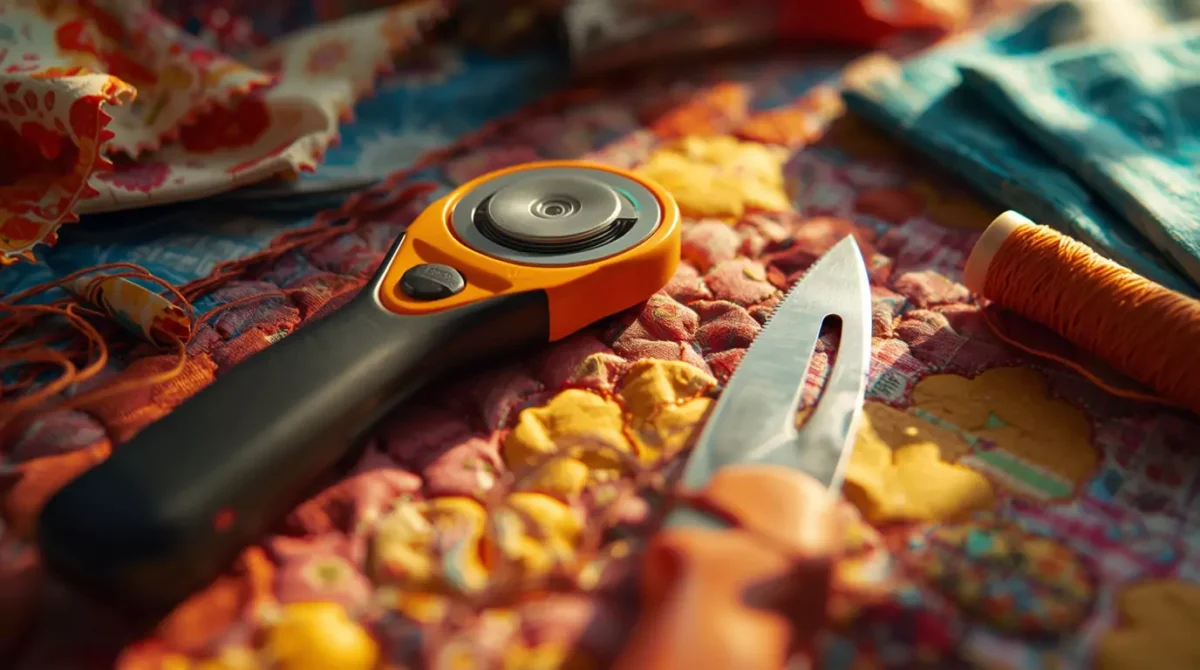
Compare today’s top-rated cordless rotary cutters here.
Cordless Rotary Cutter
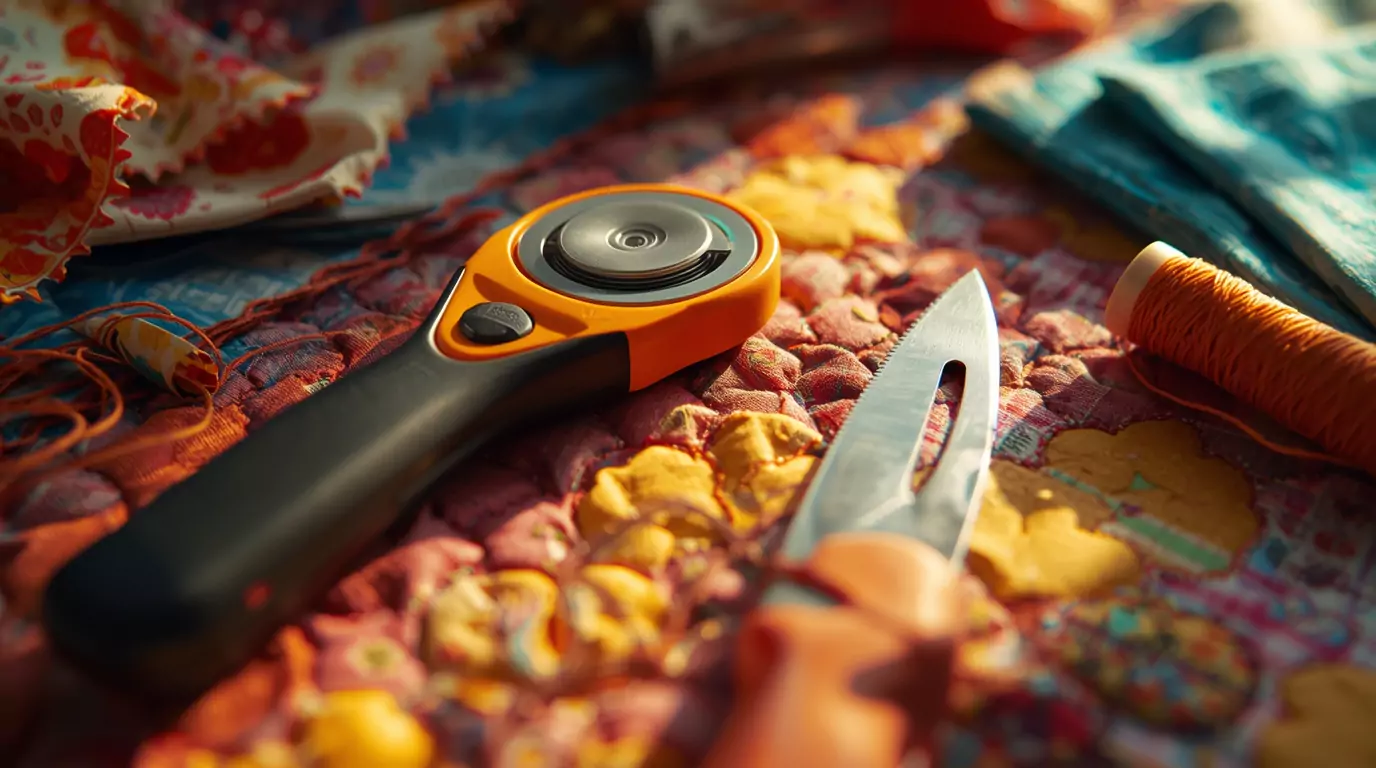
A cordless rotary cutter is a handheld cutting tool with a circular blade that rolls along fabric as you cut. The “cordless” feature means it’s battery-powered, eliminating the hassle of managing cords while working on large quilt projects spread across your cutting table.

These cutters typically feature circular blades ranging from 28mm to 60mm in diameter. The blade rotates as you push it along your cutting line, slicing through multiple layers of fabric simultaneously with minimal effort.
Modern cordless rotary cutters often include safety features like automatic blade retraction, ergonomic handles to reduce hand fatigue, and LED lights to illuminate your cutting line. They’re designed specifically for fabric work and excel at cutting straight lines and gentle curves.
Quilters love cordless rotary cutters because they can cut through 6-8 layers of cotton fabric in one pass. This capability dramatically speeds up the process of cutting quilt squares, strips, and triangles. The rolling motion also puts less strain on your wrist compared to the sawing motion required by craft knives.
Professional quilters and serious hobbyists consider cordless rotary cutters essential tools. They work best with self-healing cutting mats and clear acrylic rulers, forming the foundation of an efficient quilting workspace.
See today’s best cordless rotary cutter models on Amazon.
Craft Knife for Quilting
A craft knife (also called a precision knife or hobby knife) features a fixed, pointed blade attached to a handle. The most common type is the X-Acto knife style, though various handle shapes and blade designs exist for different cutting needs.

Craft knives require a dragging or scoring motion to cut through fabric. You apply downward pressure while pulling the blade along your cutting line. Unlike rotary cutters, craft knives work best on single layers or at most 2-3 thin fabric layers.
These knives excel at detail work where precision matters more than speed. The pointed blade tip allows you to start cuts at exact points, navigate tight curves, and cut intricate shapes that would be difficult with a rotary cutter’s circular blade.
Many quilters keep craft knives on hand for appliqué work, trimming thread chains, cutting precise points in paper piecing, and creating custom templates. They’re lightweight, portable, and require no batteries or maintenance beyond occasional blade changes.
However, craft knives have limitations for general quilting tasks. Cutting long straight lines requires steady hand control and multiple passes. The cutting motion can be tiring during extended cutting sessions, and achieving perfectly straight cuts without a ruler is challenging.
Browse craft knife options for detailed quilting work.


Cordless Rotary Cutter vs Craft Knife – Quick Comparison Table
| Feature | Cordless Rotary Cutter | Craft Knife |
|---|---|---|
| Cutting Precision | Excellent for straight lines; good for gentle curves | Excellent for intricate details and tight curves |
| Safety | Blade guards and auto-retraction; lower risk of slips | Exposed blade; higher risk of cuts without careful handling |
| Ease of Use | Minimal hand fatigue; smooth rolling motion | Requires consistent pressure; can tire hand quickly |
| Speed | Very fast for cutting strips and squares | Slower; requires multiple passes for thick materials |
| Suitable Fabrics | Multiple layers (6-8 cotton layers); all quilting fabrics | Best for 1-2 layers; struggles with thick batting |
| Learning Curve | Quick to learn; requires ruler technique | Moderate; demands steady hand control |
| Long-term Durability | Battery and blade replacement needed; sturdy construction | Very durable; only blades need replacing |
| Price | $30-$80 for quality models | $5-$25 for quality models |
Both tools serve quilters well, but in different contexts. A cordless rotary cutter handles the bulk of quilting cutting tasks efficiently, while a craft knife provides precision for specialized work.
Compare cordless rotary cutter prices on Amazon | Browse craft knife options here
Which Tool Is Better for Quilters?
For most quilting tasks, a cordless rotary cutter is the better choice because it cuts faster, handles multiple fabric layers effortlessly, and reduces hand fatigue during long cutting sessions.
Quilting involves cutting dozens or even hundreds of fabric pieces for a single project. A cordless rotary cutter excels at this repetitive work. When you’re cutting 2.5-inch strips from fat quarters or trimming blocks to size, the rotary cutter’s speed and accuracy are unmatched.
However, the best tool depends on your specific needs:
Choose a cordless rotary cutter if you:
- Cut multiple fabric layers regularly
- Work on traditional pieced quilts with lots of strips and squares
- Want to reduce wrist and hand strain
- Value speed and efficiency
- Use rulers and templates frequently
Choose a craft knife if you:
- Focus primarily on appliqué or detailed work
- Need to cut intricate curves and small shapes
- Work with paper piecing patterns
- Prefer a lighter, more portable tool
- Have a limited budget for starting out
Most experienced quilters own both tools and use them for different purposes. The cordless rotary cutter handles about 90% of cutting tasks, while the craft knife provides precision for that remaining 10% of detailed work.
For beginners just starting their quilting journey, invest in a quality cordless rotary cutter first. You can always add a craft knife later when you tackle projects requiring more detailed cutting.
Check customer reviews on cordless rotary cutters | See craft knife options for detail work
Pros & Cons of Cordless Rotary Cutters

Pros:
- Cuts multiple fabric layers simultaneously – Save time by cutting 6-8 layers in one pass instead of cutting each layer individually
- Reduces hand and wrist fatigue – The rolling motion is easier on joints compared to sawing or dragging motions
- Provides consistent, straight cuts – When used with a ruler, delivers professional-quality straight edges every time
- No cord to manage – Battery power means you can work anywhere on your table without cord restrictions
- Speeds up the cutting process – Complete cutting tasks in a fraction of the time required by other tools
- Works well with templates and rulers – The circular blade follows edges perfectly for accurate shapes
- Safer blade coverage – Many models include automatic blade guards that deploy when you release pressure
- Versatile for various quilting techniques – Handles strip piecing, block cutting, template work, and more
Cons:
- Higher initial investment – Quality models cost $30-$80 compared to $10-$20 for craft knives
- Requires blade replacements – Blades dull over time and cost $5-$15 for replacement sets
- Needs battery charging or replacement – Running out of battery mid-project can be frustrating
- Bulkier than craft knives – Less portable and requires more storage space
- Learning curve for safe use – Requires practice to maintain proper pressure and avoid blade skipping
- Less precise for intricate curves – The circular blade can’t navigate tight inside corners easily
- Must use with cutting mat – Requires a self-healing mat to protect surfaces and blade
- Can be intimidating for beginners – The exposed blade may cause anxiety until proper technique is learned
Read customer reviews before buying your rotary cutter.
Pros & Cons of Craft Knives for Quilting

Pros:
- Excellent for detailed, intricate work – The pointed blade navigates tight curves and small shapes that rotary cutters can’t handle
- Very affordable – Quality craft knives cost $5-$25, making them accessible for all budgets
- Lightweight and portable – Easy to take to quilting classes or sewing groups
- No batteries or charging needed – Always ready to use without waiting for power
- Precise starting and stopping points – The blade tip allows exact placement for cuts
- Minimal maintenance required – Simply replace blades when they dull
- Perfect for appliqué work – Cuts smooth curves in appliqué pieces with precision
- Works well for paper piecing – Trims fabric and paper accurately without disturbing stitches
Cons:
- Slow for cutting multiple pieces – Each piece requires individual attention, making large projects time-consuming
- Tires hands quickly – The dragging motion and required pressure cause fatigue during extended use
- Difficult to cut straight lines – Maintaining a perfectly straight cut without a guide is challenging
- Can only cut 1-2 fabric layers – Attempting more layers leads to uneven, ragged cuts
- Higher risk of injury – The exposed blade increases the chance of cuts if you slip
- Inconsistent pressure creates uneven cuts – Requires steady hand control throughout each cut
- Wears down blades quickly – Cutting fabric dulls blades faster than cutting paper
- Not ideal for thick materials – Struggles with batting or multiple fabric layers
Browse craft knife options and prices on Amazon.
How to Choose Between a Cordless Rotary Cutter and a Craft Knife
Making the right choice depends on several factors related to your quilting style, budget, and project types.
Consider Your Budget:
If you’re just starting out and money is tight, a craft knife provides a low-cost entry point. However, if you can stretch your budget, a cordless rotary cutter offers better long-term value through time savings and reduced frustration. Think of it as an investment in your quilting efficiency.
Evaluate Your Precision Needs:
Do you primarily make traditional pieced quilts with lots of squares and strips? A rotary cutter will serve you best. If you focus on appliqué, art quilts, or projects with lots of curved pieces, a craft knife’s precision becomes more valuable.
Think About Fabric Types and Quantities:
Cutting multiple layers of cotton quilting fabric? The rotary cutter wins hands down. Working with single layers of specialty fabrics or doing detailed template work? A craft knife provides the control you need.
Assess Handling Comfort:
If you experience arthritis, carpal tunnel, or hand weakness, the rotary cutter’s ergonomic design and rolling motion will be much easier on your joints. The craft knife’s dragging motion requires more hand strength and can aggravate existing conditions.
Consider Your Project Mix:
Many quilters find the best solution is owning both tools. Use the cordless rotary cutter for 90% of your cutting tasks, then switch to the craft knife for detailed work. This approach gives you the speed of the rotary cutter and the precision of the craft knife when you need it.
For most quilters, starting with a quality cordless rotary cutter makes the most sense. Add a craft knife later when you encounter projects that demand its specialized capabilities.
Compare cordless rotary cutter options before buying.
Step-by-Step: How to Cut Quilting Fabric Safely
Follow these steps for safe, accurate fabric cutting with your cordless rotary cutter:

- Prepare Your Workspace – Place a self-healing cutting mat on a stable table at a comfortable height. Ensure you have good lighting to see your cutting lines clearly.
- Press Your Fabric – Iron out all wrinkles and folds in your fabric before cutting. Wrinkles create bumps that affect cutting accuracy and can cause your blade to skip.
- Fold and Layer Fabric Properly – For cutting multiple layers, fold fabric selvage to selvage and smooth out any air pockets. Limit yourself to 6-8 layers for clean cuts.
- Position Your Ruler Securely – Place your acrylic ruler on the fabric, aligning it with your desired cutting line. Hold it firmly with your non-cutting hand, keeping fingers away from the ruler’s edge.
- Check Your Blade – Ensure your rotary cutter blade is sharp and properly installed. A dull blade requires extra pressure and can slip, creating safety hazards.
- Engage the Blade Safely – Release the blade guard and position the rotary cutter next to your ruler edge. Start with the blade on the cutting mat just before the fabric begins.
- Cut with Consistent Pressure – Roll the cutter along the ruler edge in one smooth motion, applying even downward pressure. Keep the blade perpendicular to the mat for clean cuts.
- Complete the Full Cut – Continue rolling until you’ve cut past the end of the fabric. Don’t stop mid-cut, as this can create notches in your fabric edge.
- Engage the Safety Guard – Immediately close the blade guard after completing each cut. This habit prevents accidental cuts when reaching for more fabric.
- Verify Your Cut – Check that you’ve cut through all layers cleanly. If you missed spots, make a second pass rather than trying to fix it with scissors.
- Store Tools Safely – When finished, close the blade guard completely and store your rotary cutter in a safe place away from children and pets.
Following these steps ensures safe, accurate cutting for all your quilting projects. Practice these techniques until they become second nature.
See the latest cordless rotary cutter models on Amazon.
Best Tools to Buy Today for Quilting
Best Cordless Rotary Cutter
When shopping for a cordless rotary cutter, look for models with these key features:
- Ergonomic handle design that reduces hand fatigue during extended use
- Automatic blade guard that deploys when you release pressure for safety
- LED work light to illuminate your cutting line in any lighting condition
- Long battery life that handles several quilts before needing a recharge
- Standard blade size (45mm) for easy, affordable blade replacements
- Comfortable grip that works for both right and left-handed quilters
Quality cordless rotary cutters typically range from $40-$80. While this seems expensive compared to craft knives, the time savings and reduced hand strain make them worthwhile investments for regular quilters.
Look for customer reviews mentioning smooth cutting action, reliable blade guards, and comfortable extended use. Avoid models with common complaints about weak batteries or blades that slip out of position.
See today’s top-rated cordless rotary cutters on Amazon.
Best Craft Knife for Quilting
For craft knives suited to quilting work, prioritize these features:

- Comfortable grip handle that won’t slip during cutting
- Sharp, replaceable blades readily available in multi-packs
- Lightweight construction that won’t tire your hand
- Safety cap to protect the blade when not in use
- Variety of blade shapes for different cutting tasks (straight, curved, chisel)
Quality craft knives cost between $10-$25 for the handle, with blade multi-packs adding $5-$15. This affordability makes them accessible for beginners and perfect as complementary tools.
Customer reviews should mention comfortable grip, precise control, and easy blade changes. Avoid models with handles that feel slippery or blades that wiggle in the holder.
Browse highly-rated craft knives for quilting detail work.
Final Verdict: Which One Should You Buy?
For most quilters, a cordless rotary cutter is the better primary cutting tool because it handles the bulk of quilting cutting tasks faster, more accurately, and with less physical strain than a craft knife.
Check the latest deals on cordless rotary cutters | Browse craft knife options
Cordless Rotary Cutter vs Craft Knife Quilting: Which One Actually Works?
Choosing the right cutting tool can make or break your quilting experience. One clean cut can feel like magic. One jagged edge? That’s enough to make you question your life choices.
If you’ve been stuck comparing a cordless rotary cutter vs craft knife quilting setup, you’re not alone. Quilters—beginners and pros alike—often debate which tool delivers better accuracy, speed, and ease.
Let’s settle it properly.
Why Your Cutting Tool Matters More Than You Think
Quilting is all about precision. Every block, seam, and edge relies on accurate cutting. Even a 1–2 mm error can throw off your entire pattern.
A good cutting tool helps you:
- Cut faster without fatigue
- Maintain consistent shapes
- Reduce fabric waste
- Improve overall quilt quality
So yes, this isn’t just about tools. It’s about results.
What Is a Cordless Rotary Cutter?
A cordless rotary cutter is an electric-powered version of the classic rotary cutter. Instead of manually pushing the blade, the motor spins it for you.
Key Features
- Battery-powered operation
- Circular blade (usually 28mm–60mm)
- Designed for smooth, continuous cuts
- Works well on multiple fabric layers
Where It Shines
Cordless rotary cutters excel when you need speed and consistency. If you’re cutting stacks of fabric or working on large quilts, this tool can save serious time.
Think of it as upgrading from a bicycle to a scooter.
What Is a Craft Knife?
A craft knife (often called an X-Acto-style knife) uses a small, sharp blade for detailed cutting.
Key Features
- Lightweight and manual
- Replaceable precision blade
- Designed for intricate work
- Requires steady hand control
Where It Shines
Craft knives work best for:
- Tight curves
- Small shapes
- Detailed appliqué
It’s more like a scalpel than a slicing tool.
Cordless Rotary Cutter Review: Performance Breakdown
Let’s talk real-world performance.
1. Cutting Speed
Cordless rotary cutters win—no contest.
The motorized blade glides through fabric quickly, especially when cutting straight lines or multiple layers.
Craft knives? Slower. Much slower. You need to guide every millimeter manually.
👉 If speed matters, cordless wins.
2. Accuracy and Precision
This one depends on the task.
- Rotary cutter: Great for straight lines and long cuts
- Craft knife: Better for curves and intricate details
If you’re chasing the best quilting cutter for accuracy, the answer isn’t one-size-fits-all.
👉 Straight cuts = rotary
👉 Detailed cuts = craft knife
3. Ease of Use
Cordless rotary cutters feel easier for beginners.
Why?
- Less hand pressure needed
- Smooth motion
- Fewer chances of uneven cuts
Craft knives demand control. A shaky hand can ruin your fabric faster than you can say “oops.”
👉 For the best cutting tool for quilting beginners, rotary cutters usually win.
4. Fabric Compatibility
Rotary cutters handle:
- Cotton
- Denim
- Batting
- Multiple layers
Craft knives work best on:
- Thin fabrics
- Single layers
- Templates and paper-backed designs
👉 For thicker materials, rotary cutters dominate.
5. Safety
Let’s be honest—both tools are sharp. But they behave differently.
- Rotary cutter: Blade retracts (safer when not in use)
- Craft knife: Exposed blade, higher risk of slips
Cordless versions add another layer—motor control. You must stay alert.
👉 Neither is “safe,” but rotary cutters are generally easier to manage.
Craft Knife for Fabric Cutting: Pros and Cons
Pros
- High precision for detailed work
- Lightweight and portable
- Affordable
- Easy blade replacement
Cons
- Slower cutting speed
- Requires steady hand
- Not ideal for thick fabrics
- Can cause hand fatigue
Cordless Rotary Cutter: Pros and Cons
Pros
- Fast cutting speed
- Handles multiple layers
- Consistent results
- Less physical effort
Cons
- Higher cost
- Requires charging
- Slight learning curve
- Not ideal for tiny details
Electric Rotary Cutter vs Manual: Is Cordless Worth It?
Here’s where things get interesting.
Manual Rotary Cutter
- Cheaper
- No battery required
- Full control
Electric (Cordless) Rotary Cutter
- Faster
- Less strain on hands
- Better for bulk cutting
If you quilt occasionally, manual works fine.
If you quilt regularly—or run a small business—the cordless upgrade makes sense.
👉 This is less about “better” and more about “how often you quilt.”
Rotary Cutter vs Scissors Fabric Cutting
You might wonder: why not just use scissors?
Here’s the difference:
| Feature | Rotary Cutter | Scissors |
|---|---|---|
| Speed | Fast | Moderate |
| Accuracy | High (with ruler) | Lower |
| Effort | Low | High |
| Best Use | Straight cuts | Small trims |
Rotary cutters outperform scissors for quilting. Scissors still help with trimming threads or quick fixes.
Precision Cutting Tools for Quilting: What Actually Works?
Every quilter eventually builds a toolkit. No single tool does everything.
Best Setup
- Rotary cutter (manual or cordless) for bulk cutting
- Craft knife for detail work
- Cutting mat for protection
- Acrylic ruler for straight lines
This combination gives you flexibility and control.
Quilting Tools Comparison Guide
Let’s simplify everything.
Choose a Cordless Rotary Cutter if you:
- Cut large amounts of fabric
- Work on big quilts
- Want faster workflow
- Prefer less hand strain
Choose a Craft Knife if you:
- Focus on detailed designs
- Work with appliqué
- Need precision over speed
- Cut single layers only
Real-Life Scenario: Which Tool Wins?
Imagine this:
You’re cutting 50 identical quilt squares.
- Craft knife: Slow, tiring, inconsistent
- Cordless rotary cutter: Fast, clean, repeatable
Now switch tasks.
You’re cutting a tiny floral appliqué shape.
- Rotary cutter: Awkward
- Craft knife: Perfect
👉 The “winner” depends on the job.
Common Mistakes Quilters Make
Let’s save you some frustration.
1. Using One Tool for Everything
No tool does it all. Use the right one for the job.
2. Ignoring Blade Sharpness
Dull blades ruin fabric. Replace them regularly.
3. Skipping a Cutting Mat
Bad idea. It protects both your table and your blade.
4. Rushing Precision Work
Speed is great—until it destroys your pattern.
Best Quilting Cutter for Accuracy: Final Verdict
If accuracy means:
- Straight lines → Rotary cutter
- Detailed shapes → Craft knife
There’s no universal winner.
But if we had to choose one overall?
👉 The cordless rotary cutter takes the lead for most quilting tasks.
Why?
Because quilting involves repetitive, straight cuts more often than intricate shapes.
Quilting Tool Buying Guide
Before you buy, consider this:
1. Your Skill Level
- Beginner → Rotary cutter
- Advanced → Both tools
2. Your Project Type
- Large quilts → Rotary
- Detailed designs → Craft knife
3. Your Budget
- Low budget → Manual rotary + craft knife
- Higher budget → Add cordless rotary
4. Comfort
If your hands get tired easily, cordless tools help.
Frequently Asked Questions
Are electric rotary cutters better than manual ones?
Electric (cordless) rotary cutters are better for speed and reducing hand fatigue. However, manual cutters offer more control and are more affordable, making them suitable for beginners.
Do rotary cutters cut more accurately than scissors?
Yes, rotary cutters provide more accurate and cleaner cuts than scissors, especially when used with a ruler and cutting mat.
What size rotary cutter is best for quilting?
A 45mm rotary cutter is the most popular choice for quilting because it balances control and cutting power. Smaller blades (28mm) are better for curves, while larger ones (60mm) handle thick layers.
What are the disadvantages of a craft knife for quilting?
Craft knives are slower, require steady hand control, and are not suitable for cutting thick or multiple layers of fabric. They can also cause hand fatigue during long sessions.
How long do rotary cutter blades last?
Rotary cutter blades typically last for several projects, depending on fabric type and usage. Cutting thick or layered fabric will dull the blade faster.
Do I need both a rotary cutter and a craft knife for quilting?
Yes, having both tools is ideal. Use a rotary cutter for straight and bulk cuts, and a craft knife for detailed and precision work.
Which is better for quilting: rotary cutter or craft knife?
A rotary cutter works better for most quilting tasks because it cuts straight lines quickly and accurately, especially through multiple fabric layers. A craft knife is better for detailed and intricate cuts like appliqué work.
Is a cordless rotary cutter worth it for quilting?
Yes, a cordless rotary cutter is worth it if you quilt frequently. It reduces hand strain, improves cutting speed, and delivers consistent results, especially for large projects.
Can you use a craft knife to cut fabric for quilting?
Yes, you can use a craft knife for fabric cutting, but it works best for precision tasks and single-layer fabric. It is not ideal for cutting multiple layers or long straight lines.
What is the best cutting tool for quilting beginners?
A manual or cordless rotary cutter is the best choice for beginners. It is easier to control, faster for straight cuts, and more efficient for common quilting tasks.
Final Thoughts: Which One Actually Works?
Both tools work. That’s the honest answer.
But they serve different purposes.
- Cordless rotary cutter = speed, efficiency, bulk cutting
- Craft knife = precision, detail, control
If you want one tool to handle most quilting tasks, go with a rotary cutter—preferably cordless if your budget allows.
If you want perfection in fine details, keep a craft knife in your kit.
Quick Summary
- Rotary cutters dominate in speed and straight cuts
- Craft knives excel in detailed work
- Beginners should start with a rotary cutter
- Advanced quilters benefit from using both
- Cordless models reduce effort and save time
In quilting, the best tool isn’t the most expensive one – it’s the one that fits your workflow.
And sometimes, the smartest move is not choosing one… but using both.